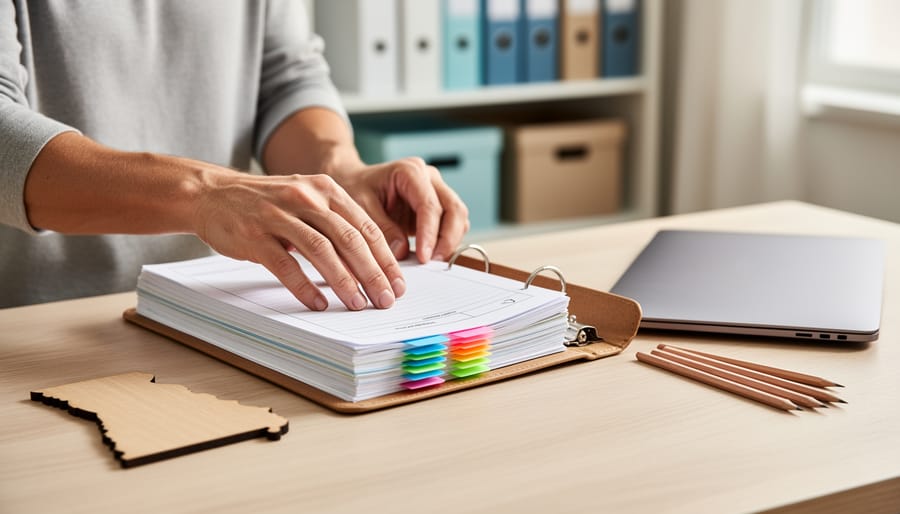



Document each school day with a simple attendance log showing dates and total hours taught—Missouri requires 1,000 hours for grades 7-12 and 600 hours for elementary students. Maintain a portfolio containing work samples from at least five core subjects: reading, language arts, mathematics, social studies, and science, with dated examples from throughout the year. Create a basic course description list that outlines topics covered in each subject area, even if it’s just bullet points noting “addition and subtraction to 100” or “Missouri history units.”
Many Missouri homeschooling families struggle with uncertainty about whether their records meet state requirements. The truth is that keeping homeschool records doesn’t require elaborate systems or expensive planners. Missouri law mandates specific documentation—an attendance record, academic records showing competent progress in required subjects, and immunization records—but provides flexibility in how you organize these elements.
Whether you’re using a three-ring binder with dividers, digital folders on your computer, or a combination approach, seeing actual examples transforms abstract requirements into manageable tasks. This article walks you through grade-specific record samples from real Missouri homeschools, demonstrates multiple organizational methods that work for different learning styles, and identifies the most common documentation gaps that could raise red flags during evaluations. You’ll discover that effective record keeping protects your homeschool legally while also creating meaningful documentation of your child’s educational journey.
What Missouri Law Actually Requires You to Keep
Missouri homeschool law is refreshingly straightforward compared to many states, though understanding exactly what you must keep versus what’s simply helpful can save you considerable stress. Under Missouri Revised Statutes Section 167.031, homeschooling parents must maintain specific records, but the requirements are more manageable than many families initially assume.
The state mandates documentation of 1,000 hours of instruction per school year, with at least 600 hours dedicated to core subjects. These core subjects include reading, language arts, mathematics, social studies, and science. While the homeschool hours requirements might sound daunting, this typically translates to about 4-5 hours daily over a standard 180-day school year. Importantly, Missouri law doesn’t require you to submit these records to anyone unless you’re under investigation or choose to transition your child to public school.
For attendance tracking, you need a basic record showing instruction occurred throughout the year. A simple calendar marking school days suffices—there’s no requirement for detailed daily logs of every subject taught. Many families use a monthly calendar with an “X” marking instructional days, which perfectly meets legal standards.
Missouri requires parents to maintain a portfolio of academic work samples, though the statute doesn’t specify quantity. Educational experts recommend keeping representative samples quarterly—perhaps 3-5 pieces per subject showing your child’s progression. A third-grader’s portfolio might include writing samples from September and May, demonstrating growth, alongside periodic math tests and science project photos.
Contrary to popular belief, Missouri law does not require standardized testing, curriculum approval, or home visits. You’re not obligated to track grades, create report cards, or maintain lesson plans, though many families find these tools personally useful. Understanding this distinction between mandatory and optional record keeping helps you focus energy where it truly matters: providing quality education while maintaining peace of mind through simple, legally compliant documentation.
Essential Records Every Missouri Homeschooler Needs
Attendance and Hour Logs
Missouri requires 1,000 hours of instruction annually, with at least 600 hours in core subjects: reading, language arts, mathematics, social studies, and science. Here’s how homeschooling families practically track these hours.
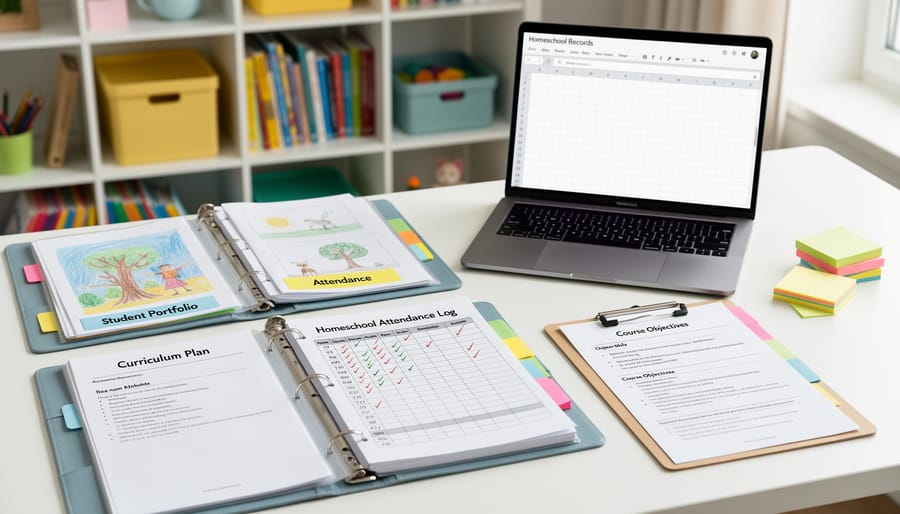
The simplest method uses a wall calendar where parents mark an “X” for each school day. Since Missouri requires documentation for 1,000 hours across approximately 180 days, this equals about 5.5 hours per school day. One mother of three elementary students keeps a kitchen calendar and writes subjects completed each day, estimating time blocks rather than exact minutes.
For more detailed tracking, many families use spreadsheet templates. A sample log might include columns for date, subjects taught, hours per subject, and daily totals. For example, a typical entry shows: October 15 – Math (1.5 hours), Reading (1 hour), Science (1 hour), Social Studies (0.5 hours), Writing (1 hour), Physical Education (0.5 hours) – Total: 5.5 hours.
Some parents prefer subject-specific hour logs, particularly helpful for demonstrating the required 600 core subject hours. One family’s reading log showed daily entries totaling 180 hours annually, well exceeding their proportional requirement.
Digital options include homeschool planning apps that automatically calculate hour totals. However, many experienced homeschoolers recommend keeping backup paper records for potential inspections.
The key is consistency rather than complexity. Choose a system you’ll actually maintain throughout the year. Missouri law doesn’t specify the tracking format, so select what works best for your family’s routine while ensuring you can demonstrate compliance if needed.
Academic Records and Portfolios
Maintaining organized academic records helps Missouri homeschoolers demonstrate educational progress and comply with state requirements. A well-structured portfolio should include representative samples from each subject area throughout the school year.
For elementary students, save at least two writing samples per month showing progression in handwriting and composition skills. Include math worksheets demonstrating mastery of concepts like addition, subtraction, and word problems. Reading logs tracking books completed, along with occasional comprehension assessments, provide evidence of literacy development. Science and social studies projects, such as posters about the solar system or state history reports, showcase learning across curriculum areas.
Middle and high school portfolios require more comprehensive documentation. Maintain grade books recording assignment scores, quiz results, and semester grades for each subject. A typical grade book might show entries like “Algebra Quiz 3: 85%, Chapter Test: 92%, Final Exam: 88%.” Save major projects such as research papers, lab reports, and creative writing pieces. Test scores from standardized assessments or subject-specific evaluations add objective measurements of academic achievement.
Organize materials using binders divided by subject with monthly or quarterly tabs, or create digital folders mirroring this structure. For example, a 7th-grade binder might contain sections for Language Arts, Mathematics, Science, History, and Electives. Include dated work samples showing both completed assignments and assessments. Documentation from homeschool field trips, such as museum worksheets or photography from historical sites, enriches portfolios with real-world learning experiences. Store portfolios for at least two years as recommended practice.
Curriculum and Planning Documentation
Missouri homeschool parents should maintain clear documentation of their educational approach and curriculum choices throughout the school year. Your curriculum documentation doesn’t need to be elaborate, but it should demonstrate thoughtful planning and educational objectives aligned with your child’s developmental stage.
A basic curriculum list can be as simple as naming the resources you’re using. For example: “Math: Saxon Math 5/4, Science: Apologia Exploring Creation with Botany, Reading: various chapter books from library, Language Arts: The Good and the Beautiful Level 2.” If you’re creating your own kindergarten homeschool curriculum, list activities by subject area such as letter recognition worksheets, counting games, and nature walks for science exploration.
Lesson plans can be detailed or broad, depending on your teaching style. Many Missouri families keep weekly overview sheets showing subjects covered and page numbers completed. For instance, a middle school weekly plan might read: “Monday – Math: Chapter 6 review, History: American Revolution reading pages 45-52, Writing: paragraph editing practice.” High school families often maintain course descriptions outlining semester objectives, such as “Biology: Students will understand cell structure, complete lab work on photosynthesis, and demonstrate knowledge of classification systems.”
Store these documents in your main record-keeping binder, organized by year or subject. Real-life example: The Johnson family from Springfield uses a simple spreadsheet listing their curriculum purchases at year-start and updates it quarterly with any additions, creating a comprehensive annual record that takes just minutes to maintain.
Real Missouri Homeschool Record Keeping Examples
Elementary Level Example
For elementary homeschoolers in Missouri, a straightforward system works best. The Johnson family’s third-grade records demonstrate an effective approach: they maintain a simple monthly log showing core subjects taught each day. Their daily schedule tracks reading (1 hour), math (45 minutes), science (30 minutes), and writing (30 minutes), totaling approximately 1,000 hours annually, well above Missouri’s recommended minimum.
Their log includes brief subject descriptions rather than detailed lesson plans. For example, one October entry reads: “Math: multiplication tables 6-8, word problems; Reading: Charlotte’s Web chapters 5-7; Science: plant life cycles observation.” This level of detail satisfies documentation requirements without creating excessive paperwork.
The family stores work samples in a three-ring binder with monthly dividers, including one math worksheet, one writing sample, and one creative project per subject monthly. They also maintain a reading list documenting approximately 150 books their daughter completed throughout the year.
For attendance, they use a simple calendar marking each instructional day with a check mark, aiming for 180 days but finding flexibility helpful during family emergencies. Their portfolio took roughly 15 minutes weekly to update, proving that compliant record keeping doesn’t require hours of administrative work. This practical system has successfully satisfied their documentation needs for three consecutive years.
Middle School Example
Middle school homeschoolers in Missouri typically maintain a daily attendance log alongside more detailed academic documentation. For a seventh grader, this might include a portfolio with quarterly reading lists (showing 8-10 books per term), completed science lab reports from a unit on ecosystems, and math work samples demonstrating pre-algebra concepts. One Missouri family documented their eighth grader’s project-based learning by maintaining a binder with project proposals, research notes, final presentations, and self-assessments for each unit study.
Course descriptions become particularly valuable at this level. A sample entry might read: “American History 1850-1900: Covered Civil War causes and effects, Reconstruction, westward expansion, and industrialization through primary source analysis, documentary films, and a semester-long research project on local historical figures.” Include the curriculum used, estimated hours (typically 120-150 per year-long course), and assessment methods.
Middle school is also the time to begin transition planning documents. Track extracurricular activities, volunteer hours, and skills development that will eventually support high school transcripts. One family created a simple spreadsheet noting their sixth grader’s community service hours, music lessons, and athletic participation, establishing a baseline for future high school credit documentation. This forward-thinking approach significantly reduces stress when transcript preparation begins.
High School Transcript Example
Creating a comprehensive high school transcript is essential for college admissions and scholarship applications. Missouri homeschool families should maintain detailed records throughout all four years to make transcript creation straightforward.
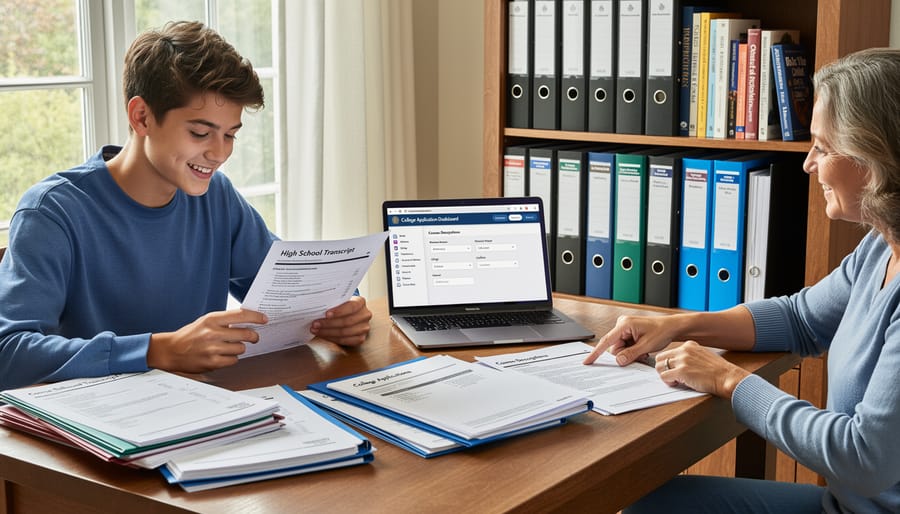
A typical high school transcript includes student identification information, courses organized by year, final grades, credits earned, and cumulative GPA. For example, a sophomore year transcript might list “Algebra II (1.0 credit, Grade: A),” “American Literature (1.0 credit, Grade: B+),” and “Chemistry with Lab (1.0 credit, Grade: A-).” Calculate credits by assigning one credit for courses meeting approximately 120-150 hours annually.
Course descriptions provide crucial context for college admissions officers. When documenting “World History,” include details like “Student examined civilizations from ancient Mesopotamia through the Renaissance, completing primary source analysis, research papers, and map studies using multiple textbooks and documentaries.”
Keep a running portfolio that includes standardized test scores (ACT, SAT, CLT), dual enrollment transcripts from community colleges, extracurricular activities with hours logged, volunteer work, awards, and leadership positions. For instance, if your student volunteers at the local library for two years, document total hours and specific responsibilities.
Many Missouri homeschool graduates successfully gain college admission with well-documented transcripts. According to recent data, homeschooled students often score above average on standardized tests when families maintain consistent academic records. Start organizing these materials freshman year rather than scrambling during senior year applications. Consider using transcript templates available through homeschool organizations or creating a simple spreadsheet that grows with each semester completed.
Simple Systems That Work for Busy Families
Digital Record Keeping Options
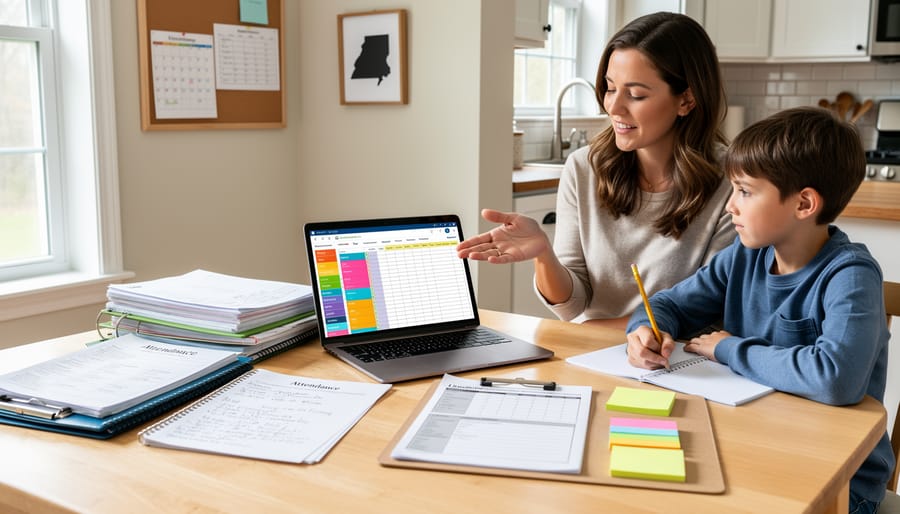
Missouri homeschooling families increasingly rely on digital tools to streamline record keeping while meeting state requirements. Popular options include Homeschool Planet, which allows parents to track attendance, log hours, and store portfolios in one centralized platform. Many Missouri families use Google Sheets to create customized attendance calendars and subject hour trackers, with one Kansas City parent reporting she maintains separate tabs for each child’s required 1,000 annual hours of instruction.
Homeschool Tracker offers both free and premium versions that generate reports showing compliance with Missouri’s core subject requirements. Springfield-area families frequently use this software to document their year-round homeschool schedule, automatically calculating instructional hours across all twelve months.
For portfolio management, Seesaw and Google Drive remain top choices. One St. Louis family photographs completed projects and uploads them directly to folders organized by subject and date, creating a visual timeline of learning. These digital records prove especially valuable during evaluations, as parents can quickly filter and display work samples demonstrating progress in reading, math, language arts, science, and social studies—Missouri’s five required core subjects.
Paper-Based Systems
Many Missouri homeschool families find success with traditional paper-based systems that keep everything tangible and organized. A three-ring binder remains the most popular choice, with dividers separating core subjects like math, reading, language arts, science, and social studies. Within each section, parents file attendance logs, completed worksheets, test scores, and work samples chronologically.
For visual learners, a color-coded filing system works effectively. Assign each child a specific color and use matching folders, labels, and tabs. One St. Louis family uses blue for their elementary student and green for their middle schooler, making it simple to grab the right records during annual portfolio reviews.
Portfolio-style systems suit project-based learners well. A large accordion folder or hanging file box can hold artwork, lab reports, and writing samples alongside documentation sheets listing activities and dates. A Springfield mother keeps monthly dividers in her accordion folder, adding a one-page summary sheet each month describing what her children studied.
Practical tip: Keep a master attendance calendar on your refrigerator or bulletin board where you check off school days as they happen. Transfer this information to your formal records monthly rather than trying to reconstruct attendance dates later. According to Missouri homeschool surveys, families who update records monthly report 40 percent less stress during year-end documentation compared to those who compile everything annually.
How Long to Keep Records (and Why It Matters)
Knowing how long to keep your homeschool records protects your family and opens doors for your student’s future. Missouri law doesn’t specify retention periods, but practical experience shows which documents deserve permanent storage and which you can eventually discard.
Keep permanently: portfolios showing each subject studied, attendance logs, and comprehensive homeschool transcripts. These form the foundation of your student’s educational history. For example, when 18-year-old Emma applied to the University of Missouri in 2023, admissions required her complete high school transcript and verification of coursework dating back to 9th grade. Families who had discarded early records faced scrambling to recreate documentation.
Financial aid applications through FAFSA often request verification of homeschool status and educational milestones, sometimes years after graduation. According to the National Center for Education Statistics, 73% of homeschool graduates pursue higher education, making college-ready records essential.
Store standardized test scores, evaluations, and course descriptions for at least seven years after high school graduation. These support scholarship applications, military enlistment, and apprenticeship programs. One Missouri family successfully accessed nursing program prerequisites five years post-graduation only because they maintained detailed science course records.
Work samples and daily lesson plans can be discarded after three years, once you’ve documented learning progression in your portfolio. However, exceptional projects demonstrating mastery make valuable portfolio additions.
For legal protection during your homeschooling years, maintain current-year complete records accessible for immediate review. This safeguards your family if educational status questions arise. Consider digital backups stored securely in cloud services for permanent records, ensuring documents survive physical damage or loss.
Common Record Keeping Mistakes to Avoid
Even diligent Missouri homeschooling families can fall into documentation traps that create unnecessary stress during state reviews or when transitioning students back to traditional schools. Understanding these common pitfalls helps you maintain compliant, comprehensive records from day one.
One frequent mistake involves vague hour tracking. Missouri requires 1,000 hours of instruction annually, with at least 600 hours in core subjects. Some families simply note “did math today” without recording actual time spent. A better approach: “Mathematics: 45 minutes (fractions practice, workbook pages 23-25).” This specific documentation provides clear evidence of both time and content covered. Research shows that families using detailed time logs report 40% fewer concerns during potential compliance questions.
Missing immunization records rank among the top oversights. While Missouri homeschoolers aren’t required to immunize, you must maintain current immunization records or signed exemption forms. Many families assume these documents stay with their previous school or doctor, only to scramble when needed for sports programs or college applications. Keep copies in your permanent file immediately upon receiving them.
Another common error involves incomplete portfolio materials. Some parents meticulously save math worksheets but neglect writing samples, art projects, or science lab notes. Missouri law doesn’t mandate portfolios, but they provide invaluable evidence of academic progress. Include diverse work samples from each subject quarterly—even photos of hands-on projects or recordings of oral presentations count.
Finally, many families fail to document field trips and extracurricular learning. That museum visit or community service project represents legitimate educational hours. Record the date, duration, subjects covered, and learning outcomes: “History field trip to Wilson’s Creek Battlefield: 3 hours (Civil War study, completed battlefield guide questions).” These detailed entries strengthen your overall documentation while capturing the rich, real-world learning homeschooling provides.
Good record keeping isn’t about creating perfect portfolios or maintaining complicated filing systems. It’s about protecting your family’s homeschooling journey and ensuring your children have the documentation they need for their futures. When you maintain consistent records, year-end reviews become straightforward rather than stressful. Many Missouri families who struggled initially found that their anxiety decreased significantly once they established a simple routine.
Start small. A basic three-ring binder organized by subject can be just as effective as expensive digital systems. One Missouri family tracked their first year using only a spiral notebook and a folder for work samples, successfully passing their evaluation with this minimal approach. The key is consistency, not perfection.
Remember that these records serve multiple purposes. Beyond meeting state requirements, they become valuable references for college applications, scholarship opportunities, and even future employment. Students applying to colleges have reported that well-maintained portfolios actually strengthened their applications by demonstrating self-discipline and organization.
Choose a system that fits your lifestyle and commit to it. Whether you prefer digital tools, traditional binders, or a hybrid approach, regular updates matter more than elaborate organization. Even dedicating fifteen minutes weekly to record keeping can transform a daunting task into a manageable habit that serves your family for years to come.