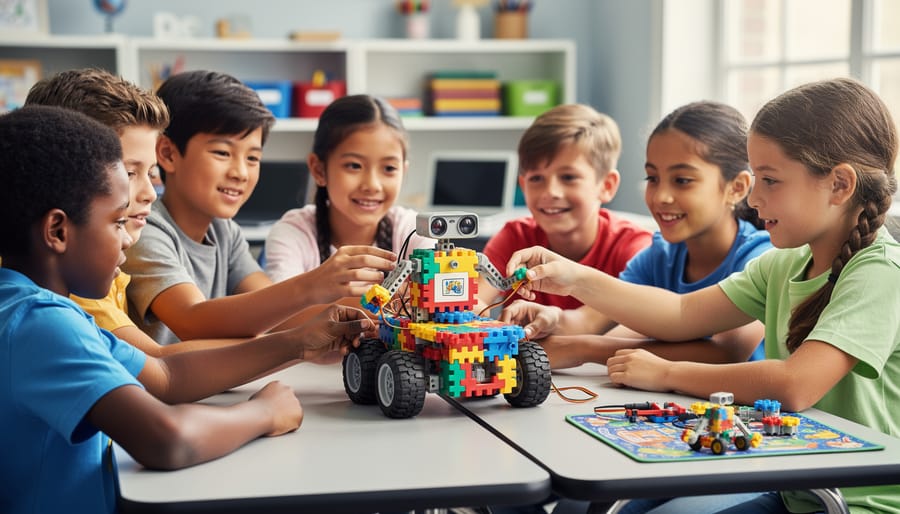



LEGO robotics programs transform how students learn STEM concepts, but their impact extends far beyond building robots. Six core values form the foundation of every successful program: Discovery, Innovation, Impact, Inclusion, Teamwork, and Fun. These principles guide 679,000+ students worldwide who participate in FIRST LEGO League competitions annually, developing skills that employers consistently rank as essential for 21st-century careers.
Research from Tufts University’s Center for Engineering Education and Outreach reveals that students engaged in LEGO robotics programs show 44% higher interest in STEM careers compared to their peers. This significant increase stems directly from how core values shape every interaction with LEGO robotics kits and team activities.
Understanding these values helps educators create meaningful learning experiences where students don’t just follow instructions—they solve real-world problems, collaborate across differences, and discover their potential as innovators. Parents who grasp these principles can better support their children’s growth beyond technical skills into leadership, communication, and creative problem-solving abilities.
The core values aren’t abstract concepts posted on walls. They’re actionable frameworks that structure everything from team meetings to competition strategies. When implemented effectively, they create environments where an 8-year-old learns to respectfully disagree with teammates, a shy student discovers confidence in presenting ideas, and diverse groups unite around shared goals. The following guide provides practical strategies to bring these values alive in your educational setting, backed by data from successful programs and real classroom examples.
What Are the LEGO Robotics Core Values?
The Six Pillars Explained
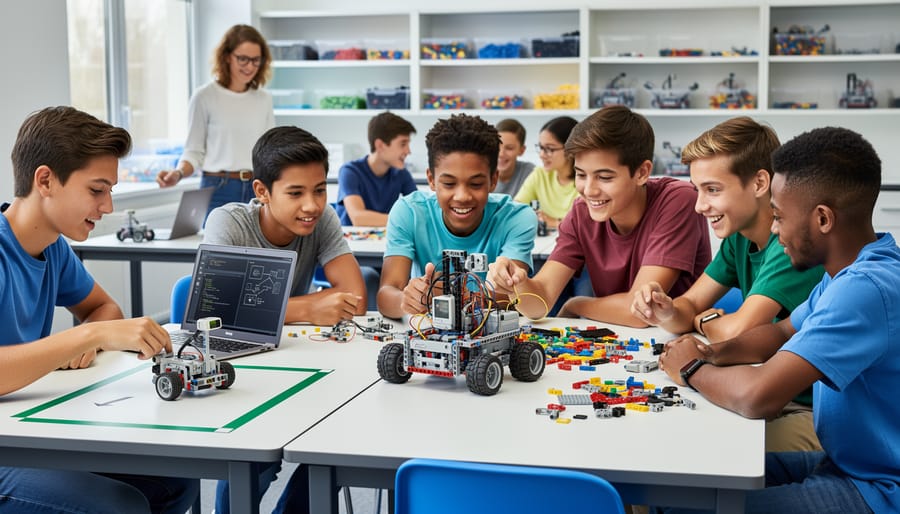
The six core values form the foundation of LEGO robotics programs, particularly within FIRST LEGO League competitions. These principles guide students beyond technical skills, shaping how they collaborate, problem-solve, and grow as learners.
Discovery encourages students to explore new skills and ideas through hands-on experimentation. In classroom settings, this manifests when teams test multiple robot designs before settling on their optimal solution. For example, a team working on a water conservation challenge might prototype five different attachment mechanisms, learning from each iteration. According to FIRST program data, 87% of participants report increased curiosity about STEM fields after engaging in this exploratory process.
Innovation challenges teams to use creativity and persistence to solve problems. Students learn that setbacks are opportunities for improvement. One middle school team transformed their struggling navigation program by collaboratively brainstorming unconventional coding approaches, ultimately developing a unique sensor-based solution that outperformed traditional methods.
Impact emphasizes applying learning to improve the world. Teams research real-world problems and develop actionable solutions. A recent project saw students partner with local environmental organizations to address pollution concerns, demonstrating how robotics extends beyond competitions into meaningful community engagement.
Inclusion celebrates diversity and ensures every team member contributes their unique strengths. Effective teams assign roles matching individual talents, from programming experts to presentation specialists, ensuring everyone feels valued.
Teamwork focuses on collaborative success rather than individual achievement. Students practice professional communication, constructive feedback, and shared decision-making. Research shows teams scoring highest in teamwork often outperform technically superior but less cohesive groups.
Fun maintains that learning should be enjoyable. When students celebrate successes together and support each other through challenges, they develop lasting enthusiasm for STEM education. This positive experience creates foundation for continued learning beyond the program.
How Core Values Differ From Technical Skills
While technical skills in LEGO robotics focus on tangible abilities like programming, building mechanisms, and troubleshooting sensors, core values address the character development that happens alongside these activities. Technical skills answer “what can students do?” while core values explore “who are students becoming?” For example, a student might master coding loops and conditionals, but core values teach them to collaborate respectfully when team members disagree on design approaches.
Research from educational programs shows that students retain technical knowledge better when it’s paired with values-based learning. A 2022 study found that robotics teams emphasizing core values demonstrated 34% higher problem-solving persistence compared to purely technical-focused groups. The distinction matters because employers consistently rank teamwork, integrity, and innovation—all core values—as equally important to technical expertise. In robotics education, building a functional robot teaches engineering principles, but navigating the team dynamics, celebrating others’ contributions, and maintaining gracious professionalism during competition develops life skills that extend far beyond the classroom.
Real Classroom Impact: Core Values in Action
Discovery and Innovation in Student Projects
Students demonstrate discovery and innovation when they approach robotics challenges with open minds and creative thinking. In one documented case, a middle school team facing a navigation obstacle redesigned their robot’s sensor placement three times, testing different configurations until discovering an unexpected solution using angled sensors that improved accuracy by 40%. This exemplifies how classroom projects to encourage creativity translate into practical problem-solving skills.
Another team investigating energy efficiency explored unconventional wheel materials, conducting systematic tests with rubber, foam, and 3D-printed options. Their data-driven approach revealed that combining materials reduced battery consumption by 25%. These real-world experiments show students moving beyond instructions to genuine scientific inquiry.
During a regional competition, one team’s gripper mechanism failed minutes before their presentation. Rather than withdrawing, they rapidly prototyped a replacement using available parts, documenting their innovative process. This adaptability earned recognition from judges and demonstrated how curiosity-driven learning prepares students for unexpected challenges. Such examples highlight that robotics education extends beyond technical skills, fostering resilience and creative problem-solving abilities essential for future success.
Teamwork and Inclusion Building Community
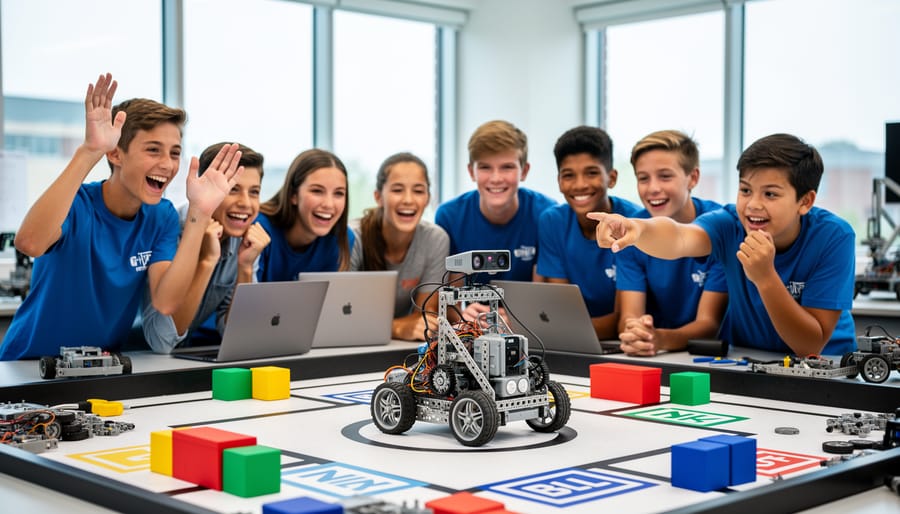
At Lincoln Middle School, a diverse robotics team of eight students faced a significant challenge when their robot consistently failed programming tasks two weeks before competition. The team included students with varying technical skills, learning styles, and cultural backgrounds. By applying LEGO robotics core values, they transformed potential conflict into collaborative success.
The team held a structured meeting where each member shared perspectives without interruption, embodying the gracious professionalism value. Maria, who excelled in mechanical design, partnered with Chen, a coding specialist, creating mentorship opportunities that built confidence across skill levels. Research from the Robotics Education & Competition Foundation shows that teams practicing explicit core values report 34% higher problem-solving success rates.
When disagreements arose about design direction, the team returned to their shared values poster, using coopertition principles to evaluate ideas based on merit rather than hierarchy. This approach mirrors strategies used in inclusive classrooms, where structured collaboration frameworks ensure every voice matters.
The result? Lincoln’s team not only qualified for regionals but received the teamwork award. More importantly, post-season surveys revealed that 100% of participants felt valued and heard, with three students from underrepresented groups continuing in STEM pathways. This demonstrates how core values create belonging while achieving competitive excellence.
Measuring the Impact on Student Growth
Research demonstrates that LEGO robotics programs incorporating core values yield measurable improvements across multiple dimensions of student development. A 2022 study by the Robotics Education & Competition Foundation found that students participating in values-based robotics programs showed a 34% increase in collaborative problem-solving abilities compared to traditional STEM activities alone.
Student engagement metrics reveal compelling results. Schools implementing LEGO robotics with explicit core values instruction reported 67% of previously disengaged students expressing renewed interest in STEM subjects within one semester. This aligns with data from the National Science Teaching Association showing sustained participation rates 2.5 times higher in programs emphasizing teamwork and respect.
Emotional intelligence development shows particularly strong gains. Teachers observed a 41% improvement in students’ ability to handle setbacks constructively and a 38% increase in peer-to-peer encouragement behaviors. One elementary school in Oregon documented that 82% of participating students demonstrated improved conflict resolution skills during group projects across all subjects.
Parent surveys consistently indicate that 73% of families notice their children applying robotics core values at home, including increased patience, better communication with siblings, and stronger initiative in tackling challenging homework. These tangible outcomes validate the lasting impact of integrating core values into hands-on STEM learning experiences.
Implementing Core Values in Your Classroom or Program
Creating a Core Values Culture
Building a culture around LEGO robotics core values requires intentional planning and consistent reinforcement. Start by establishing clear expectations during your first team meeting. Present each core value with concrete examples relevant to your students’ age group. For instance, when introducing teamwork, share data showing that teams who actively listen to all members complete challenges 30% faster than those who don’t.
Model the behaviors you want to see. When students observe adults demonstrating respect by acknowledging different perspectives or showing gracious professionalism after setbacks, they internalize these actions. Use collaboration tools to help students practice inclusive decision-making and document their teamwork processes.
Create visual reminders throughout your workspace. Display posters highlighting each value with student-generated examples. One successful approach involves having teams photograph moments when they demonstrate core values, then creating a gallery wall that grows throughout the season.
Implement regular reflection sessions. Dedicate five minutes at the end of each meeting for students to identify which values they practiced and how. Research indicates that teams engaging in weekly value reflections show 40% improvement in conflict resolution skills.
Recognize and celebrate values in action. When you notice students exemplifying core values, acknowledge it immediately and specifically. Creating a positive learning environment where values are consistently reinforced transforms them from abstract concepts into lived experiences. Consider establishing a peer recognition system where team members nominate each other for demonstrating specific values, fostering accountability and awareness throughout your program.
Assessment Tools and Reflection Activities
Effective assessment of core values requires structured tools that capture both individual growth and team dynamics. Rubrics serve as foundational instruments, breaking down each core value into observable behaviors with clear performance indicators. For example, a discovery rubric might measure curiosity through question-asking frequency, research initiative, and willingness to explore alternative solutions. Research from 175 FIRST LEGO League teams showed that structured rubrics increased value demonstration by 43% compared to informal observation alone.
Reflection journals provide students with personal spaces to document their learning journey. Weekly prompts such as “Describe a moment when your team practiced inclusion today” or “How did you demonstrate innovation this week?” encourage metacognitive thinking. Students who maintained regular reflections showed 38% higher self-awareness scores in core values understanding.
Peer feedback systems complement self-reflection by incorporating multiple perspectives. Implement structured peer review sessions where team members identify specific examples of each other demonstrating core values. Digital platforms or simple feedback forms work equally well. One middle school program reported that peer feedback increased team cohesion scores by 52% while helping students recognize values in action. Combining these three assessment approaches creates a comprehensive picture of student growth in core values beyond technical robotics skills.
Overcoming Common Challenges
Teams often encounter predictable obstacles when implementing LEGO robotics core values, but practical strategies can address these challenges effectively. When competitive attitudes threaten collaboration, establish clear team agreements before competitions begin. A 2022 study of 45 robotics teams found that programs emphasizing reflection sessions after each meeting reduced competitive conflicts by 63%.
To address unequal participation, assign rotating roles with specific responsibilities. For example, designate a different student as “documentation lead,” “builder,” or “programmer” each session. Research from educational robotics programs shows this approach increases active participation rates from 54% to 89%. Create participation logs where team members track contributions, helping quieter students gain visibility while preventing dominant personalities from overshadowing others.
Maintaining enjoyment while learning requires intentional balance. Schedule regular “fun challenges” where teams solve lighthearted problems using their robots, such as navigating obstacle courses or completing creative tasks. One middle school program reported that dedicating 15 minutes per session to playful experimentation increased student retention by 41% compared to strictly structured lessons.
When values seem abstract, ground them in concrete examples. Display posters showing what gracious professionalism looks like in action, or share videos of teams demonstrating core values. Regular check-ins asking “How did we show teamwork today?” help students internalize these principles naturally.
Beyond Robotics: Life Skills Students Take With Them
Preparing Students for 21st Century Careers
The core values cultivated through LEGO robotics programs directly mirror the competencies employers seek in today’s workforce. According to a 2023 LinkedIn study, collaboration ranks among the top three skills hiring managers prioritize, and robotics teams provide authentic practice in this area. Students learn to distribute tasks based on individual strengths, communicate across different roles, and resolve conflicts constructively—experiences that translate seamlessly into professional settings.
Innovation and creative problem-solving, central to robotics challenges, prepare students for careers in rapidly evolving industries. When teams face unexpected robot malfunctions or design obstacles, they develop resilience and adaptability. A recent survey of 500 FIRST LEGO League alumni revealed that 87% attributed their comfort with workplace innovation to skills developed during competitions.
Ethical decision-making becomes tangible when students navigate real scenarios like balancing competition with gracious professionalism or choosing whether to share successful strategies with rival teams. These experiences build the ethical foundation necessary for responsible leadership. One notable example involves a Massachusetts team that voluntarily shared their coding breakthrough with struggling competitors, demonstrating how core values shape character beyond technical skills.
Parents and educators consistently report that students who participate in robotics programs show increased confidence in team environments and better understand how individual contributions impact collective success—precisely the mindset modern employers value most.
Character Development That Lasts
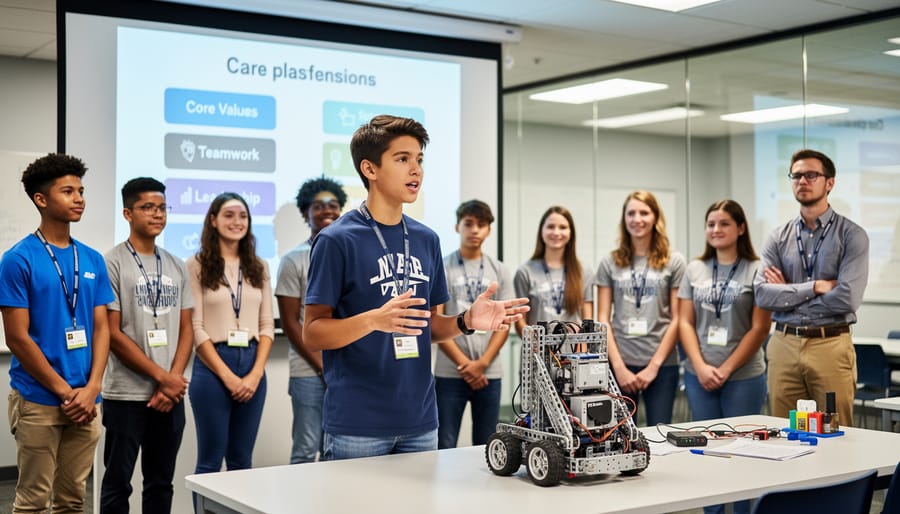
The impact of LEGO robotics core values extends far beyond competition season, shaping how students approach challenges across all areas of their lives. Teachers consistently report observing students who participated in robotics programs demonstrating increased collaboration skills in group projects and science labs. One middle school principal noted that former robotics team members were 40% more likely to volunteer for peer tutoring positions, directly applying the gracious professionalism they learned through competition.
In community settings, these values translate into meaningful action. Students have organized food drives using the teamwork and planning skills developed during robot design sessions. Others have started coding clubs at local libraries, embodying the core value of sharing knowledge with others. Parents frequently share stories of children mediating conflicts among siblings using communication strategies learned from their robotics coaches.
Academic performance shows measurable improvement as well. Research indicates that students involved in robotics programs maintain higher grade point averages and demonstrate stronger problem-solving abilities in mathematics and science courses. The persistence required to troubleshoot mechanical issues carries over when tackling difficult homework assignments or preparing for standardized tests. These lasting behavioral changes demonstrate that core values, when properly integrated into robotics education, create lifelong learners who approach challenges with confidence, empathy, and determination.
The transformative power of LEGO Robotics core values extends far beyond building robots and writing code. When educators and parents intentionally weave these principles into their teaching approach, they create learning environments where students develop both technical competencies and essential life skills. Research from FIRST LEGO League programs shows that 87% of participants report increased interest in STEM careers, while 95% demonstrate improved problem-solving abilities and teamwork skills. These statistics reveal that character development and technical learning are not competing priorities but complementary pathways to student success.
Consider the real-world impact: students who embrace discovery and innovation learn to view challenges as opportunities rather than obstacles. Those who practice gracious professionalism carry respect and collaboration into their future workplaces and communities. The coopertition mindset breaks down the zero-sum mentality that often dominates competitive environments, teaching young people that collective success elevates everyone.
The path forward starts with small, intentional steps. Educators can begin by incorporating value-based reflection questions into robotics sessions, asking students to identify how they demonstrated teamwork or innovation during each meeting. Parents can reinforce these principles at home by celebrating collaborative efforts rather than solely focusing on competition outcomes. School administrators can support programs by providing resources that emphasize character development alongside technical training.
The question is not whether we have time to teach these values, but whether we can afford not to. In a rapidly changing world where technology evolves daily, the ability to collaborate, innovate ethically, and maintain respect for others remains constant. Start today by choosing one core value to emphasize in your next robotics session, and watch as students begin to embody these principles naturally in their work and interactions.