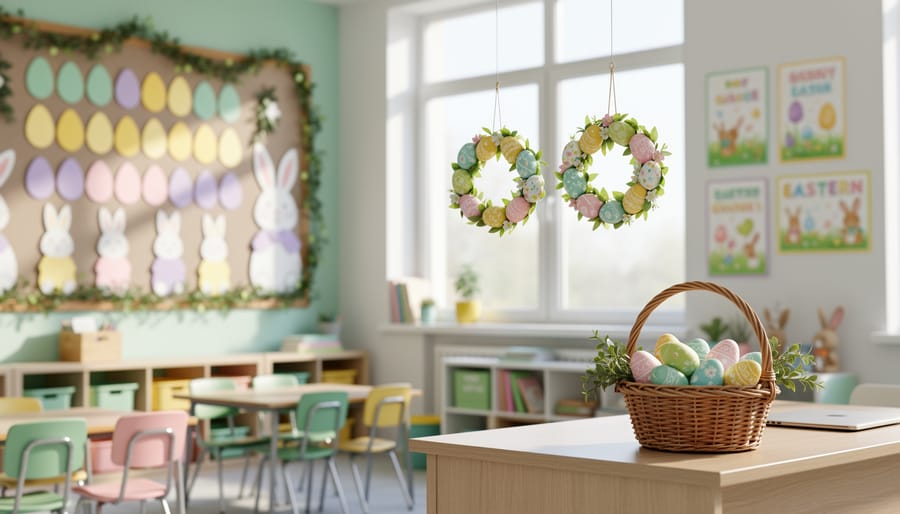



Begin decorating your classroom for Easter two to three weeks before the holiday arrives, typically in late March or early April. This window gives students enough time to enjoy the festive environment without the displays becoming stale or distracting from core instruction. Easter’s shifting date, which can fall anywhere between March 22 and April 25, makes advance planning essential for educators juggling curriculum demands with seasonal celebrations.
The timing challenge stems from Easter’s lunar calculation, moving the holiday across a five-week range each year. A classroom decorated too early risks losing its impact, while last-minute preparations often result in incomplete or rushed displays that fail to engage students. Research from classroom management studies shows that well-timed seasonal decorations can boost student engagement by 23% when introduced at optimal intervals, but the effect diminishes when displays remain static for more than four weeks.
Your decoration timeline must also account for school policies, religious observance guidelines, and the age group you teach. Elementary classrooms typically welcome more elaborate Easter themes, while middle and high school settings often require subtler seasonal touches. Many districts now request educators focus on spring motifs rather than religious symbols, broadening your decoration scope to include themes like renewal, growth, and nature alongside traditional Easter elements.
This guide provides specific installation windows, breakdown schedules, and storage strategies that respect both the holiday’s variable calendar and your instructional priorities. You’ll learn exactly when to start, how long displays should remain, and the most efficient removal process for busy educators.
Quick Answer: Optimal Timing for Easter Classroom Decorations
The optimal time to decorate your classroom for Easter is 2 to 3 weeks before the holiday. For 2026, with Easter falling on April 5, this means installing decorations between March 15 and March 22 gives you the sweet spot for maximum impact and engagement.
This window allows enough time for students to enjoy and interact with the themed environment while preventing decorations from becoming stale or losing their novelty. Starting too early, say, four weeks out, risks students tuning out the Easter theme before the actual celebration arrives. Waiting until the week before Easter often coincides with spring break schedules or leaves insufficient time for decoration preparation.
Three primary factors influence your specific timeline. First, your school calendar and any planned breaks around Easter may push your ideal date earlier or later. Second, your instructional goals matter, if you’re integrating Easter themes into science lessons about spring or cultural studies units, you might start decorations when those lessons begin. Third, consider your preparation time, especially if you’re planning student-created decorations or elaborate displays that require advance work.
The 2-3 week guideline serves as your baseline, but you’ll adjust based on your classroom’s unique circumstances and educational objectives.
Understanding Easter Timing Windows
How Easter’s Moving Date Affects Decoration Planning
Easter’s calendar instability creates a ripple effect through classroom decoration planning that catches many educators off guard. Unlike fixed holidays, Easter follows a lunar calculation, it falls on the first Sunday after the first full moon following the spring equinox. This formula produces an Easter date range spanning 35 days, from March 22 to April 25.
For 2026, Easter lands on April 5, giving you a mid-spring window. But in 2027, Easter shifts to March 28, a full week earlier. That seven-day difference means decorations that go up “three weeks before Easter” could appear in early March one year and mid-March the next. If you’re planning thematic units or coordinating with spring break schedules, you’ll need to check Easter’s date each January rather than assuming last year’s timeline still works.
The practical impact? Educators who decorate on autopilot often find themselves scrambling when Easter arrives a week earlier than remembered, or maintaining decorations longer than intended when it falls late.
Recommended Decoration Timeline by School Level
Elementary classrooms benefit from decorating three weeks before Easter, giving younger students extended exposure to seasonal themes that support learning routines and create excitement. Research on attention spans in K-5 classrooms shows that children engage more deeply with environmental changes when given time to explore and discuss them gradually, making early decoration particularly effective for this age group.
Middle school educators typically find success with a two-week window. Pre-teens respond to visual stimulation but can lose interest if themes linger too long, and they’re more likely to dismiss decorations as “babyish” if displays remain up indefinitely. Starting 14 days before Easter strikes the right balance between creating festive atmosphere and maintaining age-appropriate appeal.
High school classrooms require the most strategic timing, one to one-and-a-half weeks before Easter works best. Teenagers engage with seasonal elements when they feel fresh and relevant, but older students quickly tune out decorations that seem juvenile or overstay their welcome. Brief, targeted decoration periods respect their developing adult sensibilities while still providing visual interest.
| School Level | Start Timing | Decoration Complexity | Student Involvement |
|---|---|---|---|
| Elementary (K-5) | 3 weeks before | Elaborate, colorful | High (class projects) |
| Middle School (6-8) | 2 weeks before | Moderate, thematic | Medium (selective input) |
| High School (9-12) | 1-1.5 weeks before | Minimal, sophisticated | Low (student choice) |
These timelines align with developmental stages and attention patterns observed across thousands of classrooms. Younger students thrive with extended seasonal immersion, while older students prefer concentrated, mature approaches to holiday acknowledgment. Adjust within these ranges based on your specific class culture and how enthusiastically your students respond to environmental changes.
Coordinating with Spring Break and School Holidays
Easter’s proximity to spring break creates a timing puzzle that many educators face. In 2026, with Easter falling on April 5, many districts’ spring breaks will overlap or immediately follow the holiday, potentially cutting your decoration window short or leaving your classroom empty during the peak celebration period.
The most successful approach depends on your break’s timing. If spring break falls *before* Easter, decorate immediately upon return, students will be refreshed and receptive to new classroom energy. One third-grade teacher in Oregon reports setting up decorations the Friday students return, completing installation over the weekend for maximum Monday impact.
When spring break encompasses Easter itself, you face a choice. Some educators decorate 2-3 weeks early to capture pre-break excitement, accepting that classrooms sit empty Easter week. Others skip Easter decorations entirely, transitioning directly to general spring themes that carry through May. A middle school in Texas successfully bridges this gap by having students create take-home Easter crafts the week before break, then returning to spring-only décor.
For schools with breaks after Easter, you’re in the ideal position, decorate 10-14 days before the holiday, enjoy full student engagement during Easter week, then remove decorations during the natural break transition. This timing maximizes visibility without decoration fatigue.
Factors That Shift Your Decoration Timeline
Curriculum Integration and Learning Objectives
Curriculum-driven classrooms need Easter decorations timed to instructional sequences, not arbitrary calendar dates. If you’re launching a life-cycle science unit in early March, decorations featuring eggs, chicks, and spring growth should appear then, two or three weeks before Easter, to reinforce daily observations and vocabulary. When decorations arrive simultaneously with the content, students make immediate visual connections between what they see on walls and what they’re learning at desks.
Literature teachers planning Easter-adjacent texts (spring poetry, cultural narratives, renewal themes) benefit from decorating the week lessons begin, creating an immersive reading environment. A high school world cultures class examining Lent, Passover, and spring equinox traditions globally needs decorations that reflect this comparative approach, symbols from multiple traditions displayed thoughtfully, installed when the unit starts rather than defaulting to Christian-centric Easter imagery two weeks before the holiday.
Elementary math teachers using egg-themed counting activities or geometry lessons with basket-weaving see stronger engagement when decorations establish the thematic context before introducing worksheets. The decoration becomes the anchor, not the afterthought. Plan backward: identify your Easter-connected learning objective, then install decorations three to five days before that first lesson launches.
Religious and Cultural Considerations
Religious and cultural considerations significantly influence when, and whether, you should implement Easter decorations. Many schools serve diverse populations where families observe different traditions, celebrate alternative spring holidays, or prefer secular educational environments. Before committing to a decoration timeline, survey your specific classroom demographics and review any existing parent communications about cultural celebrations.
If you opt for secular spring decorations instead of explicitly religious Easter themes, your timing becomes more flexible, you can decorate earlier (mid-February through March) without concern about proximity to Easter Sunday itself. This approach focuses on universal spring symbols: baby animals, flowers, gardens, and renewal themes that align with science curriculum rather than religious observance. When religious elements are appropriate for your setting, time decorations closer to the actual Easter date (that two-to-three-week window) and consider sending advance notice to families explaining the educational and cultural learning objectives. Some educators successfully combine approaches by decorating with general spring themes early, then adding specific cultural elements later as part of a comparative traditions unit that explores how different communities celebrate spring.
Budget and Resource Availability
Budget realities often dictate decoration timelines more than any calendar. Most schools operate on annual or term-based budget cycles, meaning funds for Easter decorations may not become available until January or February, pushing your purchasing window closer to the holiday than you’d prefer. If you’re planning to decorate on a budget you’ll need even more lead time. DIY projects require weeks for material gathering, creation, and drying time. Dollar store supplies disappear fast once Easter approaches, so educators shopping in late March may find picked-over selections. Teachers who start procurement in early February secure better prices, fuller inventories, and adequate time for student-involved projects that stretch budgets further while building ownership.
Student Involvement and Project-Based Decoration
When students create Easter decorations themselves, add 2-3 weeks to your standard timeline. A classroom filled with student-made paper basket weavings, painted egg garlands, or collaborative murals requires extended work sessions that can’t be rushed.
Start these projects in early March for an April Easter. Break creation into manageable chunks: one week for planning and material gathering, one week for construction during art time or centers, and several days for installation. This phased approach prevents the frantic last-minute scramble that compromises both decoration quality and learning value.
The educational payoff justifies the longer timeline. Students develop fine motor skills through cutting and assembly, practice following multi-step directions, and take genuine ownership of their classroom environment. Third-graders who spend three weeks creating tissue-paper spring flowers display them with pride, and remember the associated science lessons about pollination far longer than if you’d simply hung store-bought decorations overnight.
Types of Easter Classroom Decorations and Installation Timing
Quick-Install Decorations (1-2 Days Before)
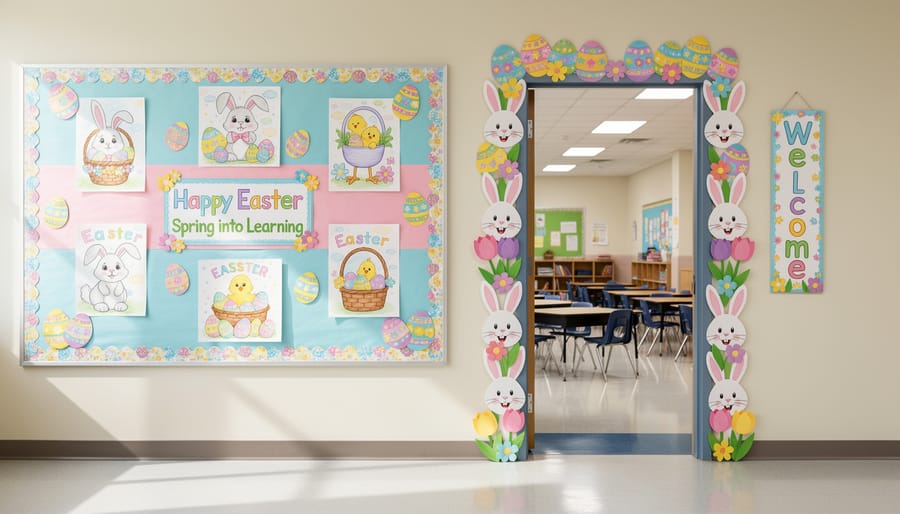
Sometimes Easter sneaks up faster than planned, or you simply want to avoid weeks of visual distraction before the holiday. Quick-install decorations solve both problems. Pre-made banners take five minutes to hang and transform a bulletin board or doorway. Vinyl window clings peel and stick without residue, letting you add pastel eggs or spring flowers to glass surfaces instantly. Table centerpieces, small baskets filled with plastic eggs or spring greenery, need no installation at all. String lights with egg or bunny shapes clip onto existing displays in minutes. Printable door signs and welcome posters require only a printer, laminator if available, and tape. These last-minute additions create festive atmosphere without cutting into instructional time or requiring student participation, making them ideal for educators working within tight schedules or unexpected calendar changes.
Medium-Effort Displays (1 Week Before)
Medium-effort displays strike the balance between impact and time investment, making them ideal for educators who want meaningful Easter presence without overwhelming their schedule. Starting one week before Easter gives you enough runway to execute these projects during planning periods or after school.
Bulletin board redesigns anchor this category, transforming existing displays with Easter-themed borders, fresh backgrounds, and student work arranged around spring motifs. You can repurpose your current board structure while adding seasonal flair through coordinated paper, die-cuts, and thoughtful layouts.
Window clings and coordinated wall decals work exceptionally well at this timeline. They require careful placement but no permanent adhesive, and you can map out your design in advance. Pair them with matching door decorations or ceiling hangings to create visual continuity across your classroom.
Consider creating small learning stations with Easter elements, a reading corner with spring-themed pillows and book displays. These functional decorations serve double duty, supporting your curriculum while contributing to the seasonal atmosphere.
Elaborate Themed Environments (2-3 Weeks Before)
Elaborate themed environments transform classrooms into immersive Easter learning spaces but demand significant lead time. Starting 2-3 weeks before Easter allows you to coordinate student-created elements, integrate Easter art activities into lesson plans, and build multi-station displays that reinforce curriculum goals. This timeline accommodates collaborative projects like paper mache eggs, student-painted murals, or cardboard garden scenes that need drying time between sessions. You’ll also have space to incorporate student-loved art elements such as texture walls, interactive displays, or color-coordinated reading corners that tie Easter themes to ongoing learning objectives. Elementary teachers often use this extended period to build excitement gradually, unveiling new sections of the themed environment as students complete related assignments or earn privileges, which maintains engagement without overwhelming the space all at once.
Practical Implementation Strategies
Successful Easter classroom decoration begins with systematic planning weeks before the first bunny appears on your bulletin board. By breaking the process into distinct phases, you minimize last-minute stress and create a decoration timeline that works with your teaching schedule, not against it.
Start with a clear implementation plan that accounts for your specific constraints and resources. Here’s a practical sequence that experienced educators follow:
- Check Easter’s 2026 date (April 5) and mark your school calendar for breaks, testing periods, and other conflicts that might affect your decoration window.
- Assess how Easter decorations connect to your curriculum, whether you’re teaching spring science units, cultural studies, or simply creating a festive learning environment.
- Inventory materials you already own from previous years, noting what needs replacement or refreshing to avoid redundant purchases.
- Plan new purchases or DIY creation projects, building in time for online shipping delays or craft session scheduling.
- Schedule specific dates for student involvement if you’re incorporating collaborative decoration projects, ensuring these align with lesson plans.
- Set your installation date based on your chosen timeline (typically mid-to-late March for Easter 2026), blocking off the necessary preparation time.
- Prepare your removal timeline now, mark when decorations come down and where storage materials are located to streamline the process later.
Once your plan is set, create a simple checklist for installation day. Group decorations by location rather than type: everything for the reading corner in one box, bulletin board materials in another, ceiling decorations together. This location-based organization cuts your setup time significantly.
Recruit help strategically. Upper elementary students can handle most decoration tasks with supervision, while younger children excel at placing pre-cut shapes or arranging items on low surfaces. Even a single parent volunteer can reduce your installation time by half. The key is having materials organized and tasks clearly defined before your helpers arrive, turning what might take you three hours solo into a forty-minute group effort.
Aftercare: When and How to Remove Easter Decorations
Determining the Right Removal Date
The day after Easter Monday typically marks the practical removal window for most classroom decorations, though educational considerations may extend this timeline. If Easter falls during spring break, remove decorations during the first school day back to maintain a fresh learning environment. However, if you’ve integrated Easter themes into an ongoing science unit about life cycles or spring ecology, keeping relevant displays for an additional week supports continuity.
Student attachment presents another timing consideration. Elementary students especially form connections with seasonal displays they helped create. Announce removal plans a few days ahead, giving younger learners mental preparation time. Some educators designate the Friday after Easter as “decoration takedown day,” involving students in careful removal as a classroom responsibility lesson.
For schools where Easter precedes spring break by a week or more, monitor decoration relevance. Pastel eggs and bunnies lose instructional value once the holiday passes, while broader spring themes (flowers, growth, weather) can reasonably stay. The general rule: remove explicitly Easter-specific decorations within five school days post-holiday, while spring elements can transition into your next seasonal theme through late April.
Storage and Preservation for Future Years
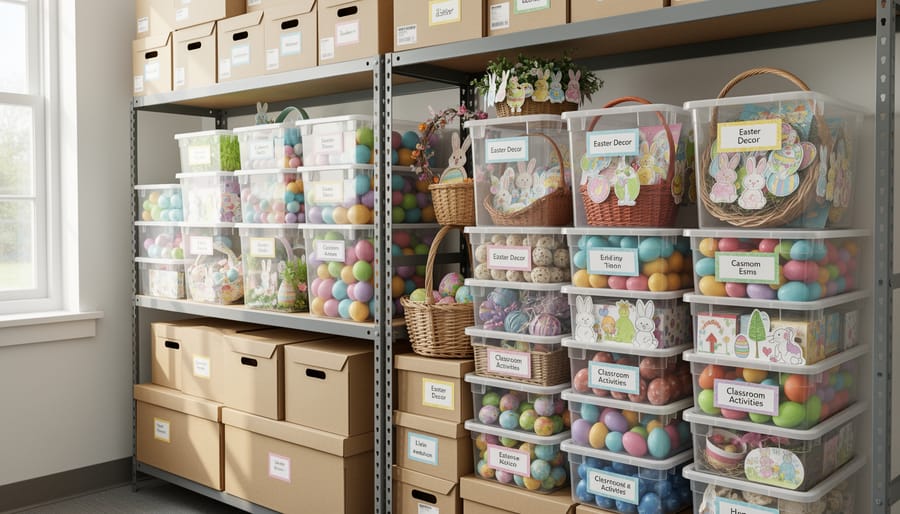
Investing time in proper storage pays off dramatically when March rolls around again. Clear plastic bins let you see contents at a glance, while detailed labels noting “Easter 2026, Bulletin Board Set A” or “Egg Garland, Primary Colors” eliminate guesswork. Snap a quick photo of assembled displays before disassembly; next year, you’ll have a visual reference that saves hours of trial-and-error arrangement.
Follow these storage best practices to protect your investment:
- Use clear, stackable bins with secure lids labeled by decoration type and year used
- Photograph completed displays before taking them down for quick setup reference
- Note condition issues on labels (“bunny missing ear, repair needed”) for summer prep
- Maintain a simple inventory spreadsheet tracking what you own and where it’s stored
- Choose climate-controlled locations when possible to prevent warping, fading, or mildew
- Discard damaged items immediately rather than storing broken decorations you’ll never fix
Following classroom storage safety guidelines ensures bins don’t create hazards in storage closets or off-site areas. Veteran teachers often dedicate one master bin for frequently reused core items (pastel tablecloths, egg-shaped cutouts) separate from specialized pieces used only occasionally. This tiered system means you can grab essentials quickly while keeping specialty items protected until needed.
Transitioning to Late Spring Themes
Once Easter decorations come down, you’re left with a visual gap that needs filling, and late April through June offers rich thematic opportunities that keep your classroom energized.
The simplest transition: retain spring elements while removing explicitly Easter items. Keep flower displays, pastel colors, and nature-themed bulletin boards, but swap bunny cutouts for butterflies, ladybugs, or generic garden imagery. This approach requires minimal effort while maintaining seasonal cohesion.
For elementary classrooms, consider growth and life cycle themes that extend spring learning. Plant displays, caterpillar-to-butterfly progressions, or weather tracking boards provide educational continuity. Middle and high school spaces benefit from shifting toward end-of-year motivation, achievement boards, summer reading previews, or reflection spaces that acknowledge the approaching transition.
Teachers at Riverside Elementary successfully bridge this gap by involving students in the redesign. A “Design Your Dream Classroom” project during the first week after Easter removal gives students ownership while you gain fresh decorative content that carries through May and June.
Common Questions About Easter Classroom Decoration Timing
The timing questions educators face when planning Easter classroom decorations often involve balancing enthusiasm with practicality, navigating school policies, and managing logistical constraints. These common concerns reflect the real challenges teachers encounter when creating seasonal learning environments.
Is it too early to decorate in February?
Yes, February is generally too early for Easter decorations, even when Easter falls in late March. Most students lose interest in seasonal displays after two to three weeks, making mid-March the earliest practical start for most classrooms.
What if Easter falls during spring break?
When Easter coincides with spring break, decorate three to four weeks before the holiday to ensure students experience the themed environment. Remove decorations the week you return from break or transition them to general spring themes.
How do I handle secular versus religious decoration requests?
Focus on spring symbols like eggs, bunnies, chicks, and flowers rather than explicitly religious imagery. This approach celebrates the season while respecting diverse family backgrounds and typically aligns with public school guidelines.
Should high school classrooms be decorated for Easter?
High school decoration depends on your subject and student population. Subtle spring accents work better than elaborate displays, and connecting decorations to curriculum content increases their appropriateness for older students.
Installation time concerns frequently arise during planning stages. Most quick-install decorations take 30 minutes to two hours depending on classroom size and complexity. Bulletin boards typically require one to two hours for complete redesign, while elaborate themed environments with student participation may span several class periods over multiple days. Planning installation during prep periods, lunch breaks, or after school prevents disrupting instructional time.
Storage and reusability questions also surface regularly. Laminated student work, quality fabric banners, and durable three-dimensional displays justify storage space for future years, while paper decorations and perishable items should be recycled after the season ends. Label storage containers by theme and year to streamline future setup.
Budget constraints prompt questions about timing purchases. Shopping clearance sales immediately after Easter provides materials for the following year at significant discounts. This forward-thinking approach allows educators to spread decoration costs across fiscal years rather than absorbing them in a single budget cycle.
Factors that shift timing
Several practical realities may push your decoration schedule earlier or later than the standard two-to-three-week window. Standardized testing periods often force delays, many educators wait until after spring assessments conclude to avoid visual distractions during exam weeks. If your state tests run through mid-April, you might postpone decorating until the week before Easter even if that’s cutting it close.
Weather disruptions also play a role. Late winter storms can close schools for days, compressing your available preparation time. Building on that point, sudden schedule changes like emergency drills or assembly preparations can consume the setup time you’d allocated for decorating.
Parent-teacher conferences and open houses sometimes accelerate timelines. When families visit during Easter season, some teachers install decorations a week earlier than planned to showcase a festive classroom environment.
Finally, shared spaces complicate timing. If you teach in a room used by multiple educators or move between classrooms, you’ll need to coordinate decoration plans with colleagues and potentially compromise on your ideal schedule. Art teachers and specialists face this challenge most frequently, often decorating later or choosing temporary options that travel between rooms.
Timing your Easter classroom decorations strategically, generally that 2-3 week window before Easter Sunday, sets you up for maximum student engagement without overstaying the season’s welcome. But the “perfect” timeline isn’t one-size-fits-all. Your curriculum objectives, student demographics, available prep time, and school calendar all matter more than any rigid rule.
The educators who see the biggest impact from seasonal decorations are those who view them not as standalone décor, but as extensions of learning. When your Easter display connects to spring science concepts, cultural discussions, or student-created art projects, the decorations earn their wall space. They become environmental teaching tools rather than just festive backdrops.
Track what works in your classroom this year. Note when students stopped noticing the decorations, when you wished you’d started earlier to support a lesson, or when removal felt premature. These observations build your personal decoration playbook, one that reflects your teaching style and your students’ needs.
Seasonal environments matter. They mark time, celebrate renewal, and signal that your classroom is a dynamic, responsive space. Getting the timing right amplifies all those benefits while keeping your workload manageable year after year.