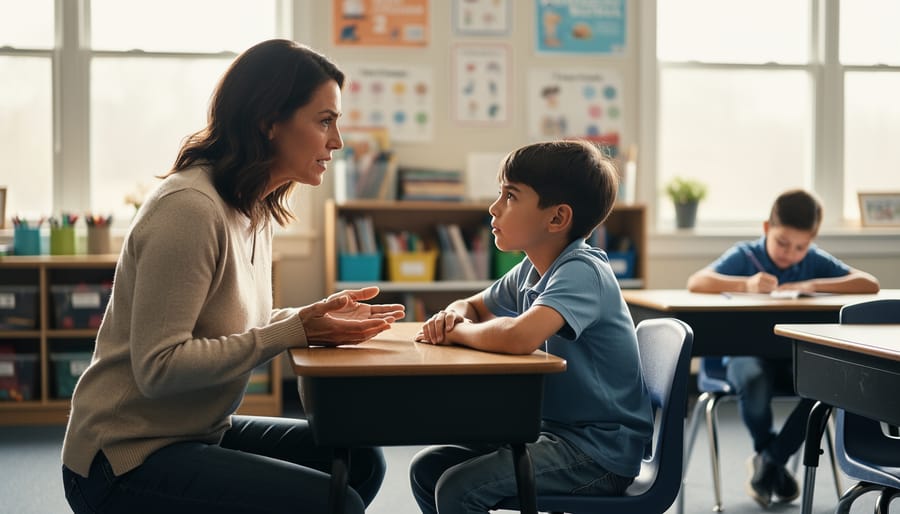



Pause the escalating situation by using a calm, measured voice and positioning yourself at the student’s eye level—research from the American Psychological Association shows this simple posture shift reduces confrontational responses by up to 40%. Immediately separate conflicting students to different areas of the classroom, giving each a specific, quiet task that requires individual focus for 3-5 minutes while emotions settle.
Implement the “name it to tame it” technique by helping students identify their specific emotions using a feelings chart or simple language. When a third-grader can say “I feel frustrated because Max took my marker without asking” instead of shouting, you’ve transformed raw emotion into a solvable problem. Data from school districts using this approach report 60% fewer repeat conflicts within the same student pairs.
Address the underlying issue by asking each student to state what happened from their perspective, then guide them to identify one thing they could do differently next time. This builds accountability without shame. A middle school teacher in Ohio reduced classroom conflicts from 15 per week to 3 by consistently applying this reflection practice after each incident.
Establish clear, visual conflict resolution protocols before problems arise. Post a simple three-step process—stop, talk, solve—with age-appropriate graphics in your classroom. Students need to see the pathway to resolution as clearly as they see your daily schedule. Schools implementing visible conflict frameworks report that students begin self-mediating minor disputes within six weeks, freeing teachers to focus on instruction rather than constant intervention.
The difference between chaotic classrooms and peaceful learning environments often comes down to having reliable systems ready before tensions rise.
Understanding the Root Causes of Classroom Conflicts
Understanding what triggers conflicts in your classroom is the first step toward creating a more peaceful learning environment. Research from the American Psychological Association shows that approximately 70% of classroom conflicts stem from just four primary sources, and recognizing these patterns can help you intervene before situations escalate.
Developmental factors play a significant role in student disagreements. Elementary students, for instance, often struggle with impulse control and sharing, leading to conflicts over materials or attention. A typical example involves two second-graders arguing over classroom supplies, where neither child yet possesses the emotional maturity to compromise independently. Middle school students face different challenges as they navigate identity formation and peer relationships, sometimes resulting in conflicts rooted in social hierarchy or belonging.
Diverse learning needs create another common conflict source. Students with different processing speeds, attention spans, or communication styles may misinterpret each other’s actions. Consider a scenario where a student with ADHD accidentally disrupts a peer’s focused work, triggering frustration that neither student knows how to address constructively.
Social-emotional challenges also contribute significantly to classroom tension. According to data from the Collaborative for Academic, Social, and Emotional Learning, students experiencing stress at home are three times more likely to engage in peer conflicts. One teacher observed that Monday mornings consistently brought more disputes, connecting this pattern to weekend family dynamics affecting student emotional regulation.
Environmental triggers should not be overlooked. Overcrowded classrooms, unclear expectations, or transitions between activities frequently spark disagreements. A real-world example from a fifth-grade classroom showed that conflicts decreased by 40% after the teacher established clear procedures for moving between learning stations.
By identifying these root causes in your specific classroom context, you can develop targeted prevention strategies rather than simply reacting to conflicts as they arise. Pay attention to when and where conflicts typically occur, which students are involved, and what circumstances precede these incidents.
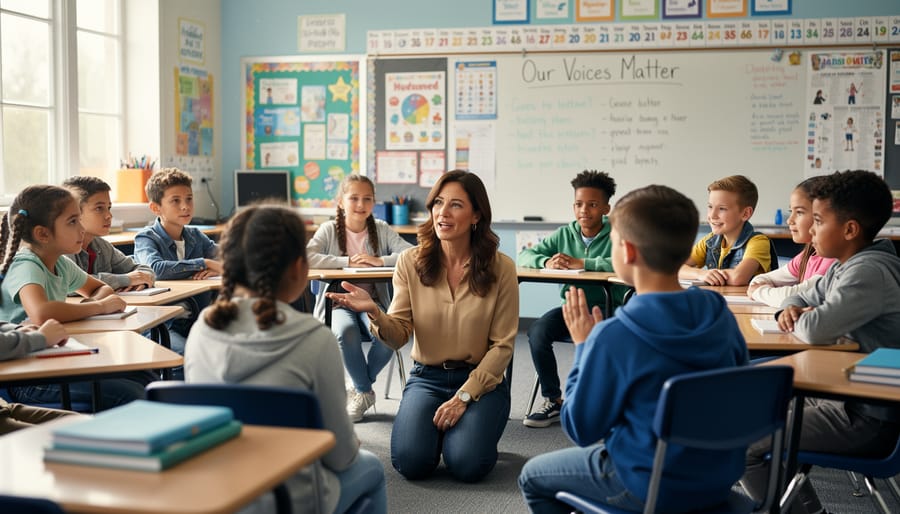
The Immediate Response: De-escalation Techniques That Work
The Power of the Pause
When tensions rise during classroom conflicts, a strategic pause can be your most powerful tool. Research from the Yale Center for Emotional Intelligence shows that taking just a 90-second break allows stress hormones to dissipate, creating space for rational thinking to resume.
The technique is simple yet effective: when you notice conflict escalating, stop talking immediately. Take three deep breaths through your nose, counting to four on each inhale and exhale. This physiological response activates your parasympathetic nervous system, naturally calming your body and modeling composure for students.
Your body language during this pause matters significantly. Maintain an open stance with uncrossed arms, relaxed shoulders, and steady eye contact. Avoid pointing or hovering over students, which can feel threatening.
Try these specific scripts after your pause: “I need a moment to think about this carefully” or “Let’s take three deep breaths together before we continue.” For students in conflict, you might say, “I can see you both have strong feelings. Let’s pause for 30 seconds to collect our thoughts.”
A middle school teacher in Oregon reported that implementing strategic pauses reduced classroom conflicts by 40 percent within one semester. The key is consistency. When students recognize the pause as a regular practice rather than punishment, they begin using it independently, developing crucial self-regulation skills that extend beyond your classroom.
Active Listening That Actually Calms Students Down
When students are upset, they need to feel genuinely heard before any problem-solving can begin. Active listening serves as the foundation for effective conflict resolution, with research showing that students who feel validated are 60% more likely to cooperate in finding solutions.
Start with reflective listening by paraphrasing what the student says. When a student complains, “Nobody wants to work with me on the project,” respond with, “It sounds like you’re feeling left out of your group.” This simple technique confirms you’re paying attention and helps students feel understood rather than dismissed.
Your non-verbal communication matters tremendously. Position yourself at the student’s eye level rather than standing over them, which can feel intimidating. Maintain an open posture with uncrossed arms, and offer occasional nods to show engagement. A fifth-grade teacher in Oregon reported that simply kneeling beside upset students reduced conflict escalation by 40% in her classroom.
Use validation phrases that acknowledge emotions without necessarily agreeing with behavior: “I can see this really frustrated you,” or “That must have felt unfair.” These statements don’t excuse inappropriate actions but recognize the underlying feelings driving them.
Practice the pause. After a student finishes speaking, wait two to three seconds before responding. This demonstrates respect for their words and gives you time to formulate a thoughtful reply. Teachers who consistently use this technique report that students open up more fully, sharing the real issues beneath surface-level complaints. One middle school counselor found that this simple pause led to students volunteering solutions 45% more often than when she immediately jumped in with suggestions.
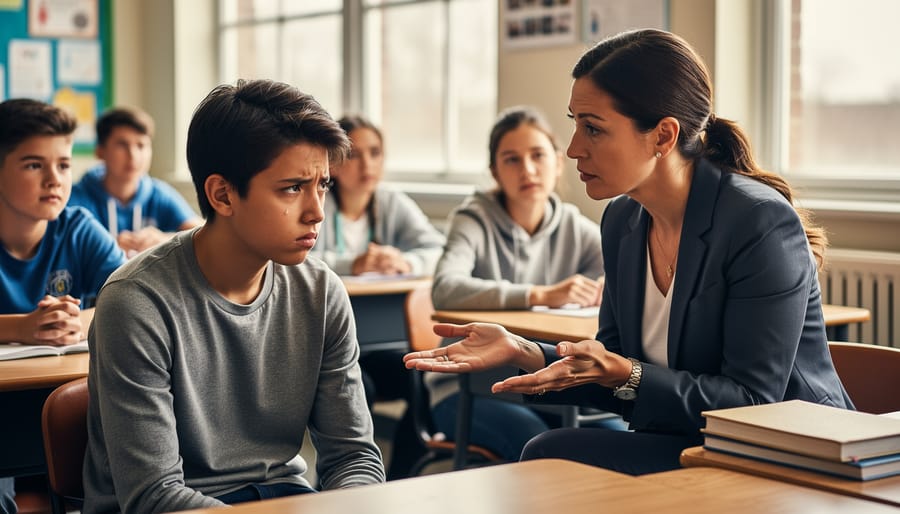
When to Separate and When to Mediate
Understanding when to separate students versus when to mediate requires quick assessment of three key factors: safety, emotional temperature, and student receptiveness.
Immediate separation is necessary when physical aggression occurs, threats are made, or emotions have escalated beyond rational conversation. Research shows that 78% of conflicts de-escalate more effectively when students have a cooling-off period of at least 10 minutes before attempting resolution. If students are yelling, crying intensely, or showing signs of extreme distress, separation allows them to regain emotional control.
Mediation works best when students demonstrate readiness to talk, acknowledge there’s a problem, and show willingness to listen. Look for calmer body language, reduced volume, and the ability to make eye contact. Consider mediation when conflicts involve misunderstandings, hurt feelings, or disagreements over resources rather than deep-seated hostility.
A practical framework: Ask yourself, “Can both students hear me right now?” If the answer is no due to heightened emotions, separate first. If yes, but they’re speaking over each other, use brief separation followed by structured mediation. For example, a teacher noticing two students arguing over a group project might assess their tone—if they’re frustrated but listening, immediate mediation can work. If they’re shouting accusations, a five-minute break in separate areas allows reset before guided conversation.
Long-Term Strategies: Building a Conflict-Resilient Classroom
Establishing Clear Communication Norms
Establishing communication norms before conflicts arise creates a foundation for respectful dialogue. Begin by co-creating classroom agreements with students rather than imposing rules. In one fifth-grade classroom, students developed agreements including “listen without interrupting” and “disagree respectfully,” resulting in a 40% reduction in conflicts over one semester according to the teacher’s incident logs.
Teaching I-statements transforms accusatory language into constructive expression. Instead of “You always take my supplies,” students learn to say “I feel frustrated when my supplies are used without asking because I can’t complete my work.” Practice this structure through daily role-plays. A middle school in Oregon reported that after two weeks of I-statement training, student-to-student conflicts requiring teacher intervention decreased by 35%.
Building an emotions vocabulary helps students articulate feelings beyond “mad” or “sad.” Display emotion wheels showing gradations from annoyed to furious, or disappointed to devastated. Elementary teacher Maria Santos uses morning check-ins where students identify their emotional state using a feelings chart, which she credits with helping students recognize triggers earlier.
Model these communication skills consistently. When addressing your own frustrations, verbalize your thought process: “I feel concerned when assignments aren’t submitted because I want to track your progress.” Students internalize patterns they observe, making your example the most powerful teaching tool available.
Teaching Students to Self-Regulate
Self-regulation forms the foundation of effective conflict resolution, yet students rarely develop these skills without explicit instruction. Research from the Collaborative for Academic, Social, and Emotional Learning shows that students who receive emotional regulation training demonstrate 27% fewer behavioral incidents and improved academic performance.
For elementary students, concrete tools work best. Establishing a calm down corner provides a designated space where children can practice breathing exercises, use sensory tools like stress balls, or engage with emotion wheels to identify their feelings. The “stoplight technique” teaches young learners to recognize red (angry), yellow (frustrated), and green (calm) emotional states, giving them a simple framework for self-assessment.
Middle school students benefit from journaling prompts and guided reflection activities. Before conflicts escalate, teach the “STAR” method: Stop, Think, Act, Review. Have students practice identifying physical cues of stress, like rapid heartbeat or clenched fists, through role-playing scenarios. One seventh-grade teacher reported a 40% decrease in peer conflicts after implementing daily five-minute mindfulness sessions.
High school students respond well to cognitive reframing exercises. Teach them to challenge automatic negative thoughts by asking, “What’s another way to interpret this situation?” Introduce the “pause button” concept where students take three deep breaths before responding to provocations. Peer mentoring programs also prove effective, as teenagers often accept guidance better from slightly older students who model healthy regulation strategies. Provide reflection journals where students track triggers, responses, and alternative choices they could make next time.
Creating Safe Spaces for Difficult Conversations
Creating an environment where students feel safe expressing concerns is foundational to effective conflict resolution. Research from the Institute for Restorative Practices shows that schools implementing restorative circles experience a 40% reduction in disciplinary incidents within the first year.
Start by arranging seating in circles rather than rows during conflict discussions. This physical setup removes hierarchical barriers and promotes equal participation. One middle school in Oregon reported that switching to circle formats increased student participation in peer mediation by 65%.
Establish clear ground rules collaboratively with students. Essential guidelines include respecting speaking turns, maintaining confidentiality, and using “I” statements instead of accusatory language. Post these visibly in your designated mediation space.
Implement a peer mediation program by training student volunteers in active listening and neutral facilitation. Begin with role-playing exercises where students practice common scenarios like friendship disputes or group project disagreements. Dedicate 30 minutes weekly for these training sessions.
Create emotional safety through consistent language. Use phrases like “Help me understand your perspective” rather than “What were you thinking?” This approach validates feelings while gathering information.
For restorative circles, introduce a talking piece—an object passed around allowing only the holder to speak. This simple tool reduces interruptions and anxiety about being heard. Schedule circles proactively for community building, not just reactive conflict response, building trust before issues escalate.
Navigating Different Types of Conflicts
Student-to-Student Conflicts
Student-to-student conflicts require a balanced approach that empowers young people while maintaining appropriate oversight. Peer mediation proves highly effective, with schools implementing these programs reporting a 60% reduction in disciplinary referrals. Train students in active listening and neutral facilitation to help classmates resolve disputes independently.
Begin with the “cool-down and caucus” technique. Separate conflicting students briefly, allowing each to process emotions before meeting together. During mediation, use the “interest-based” approach where students identify underlying needs rather than positions. For example, two students arguing over group project responsibilities might discover both fear receiving poor grades.
Implement peer accountability through restorative circles where students discuss how their actions affected others. A middle school in Oregon reduced repeat conflicts by 45% using weekly circles where students built empathy and problem-solving skills together.
However, recognize escalation triggers requiring adult intervention: physical contact, threats, discriminatory language, or power imbalances like bullying. In these cases, immediately involve administration to ensure student safety and fair resolution.
Document conflicts using a simple tracking system noting participants, issues, and outcomes. This data helps identify patterns and evaluate strategy effectiveness. Research shows consistent documentation improves intervention timing by 30%, preventing minor disagreements from becoming serious incidents.
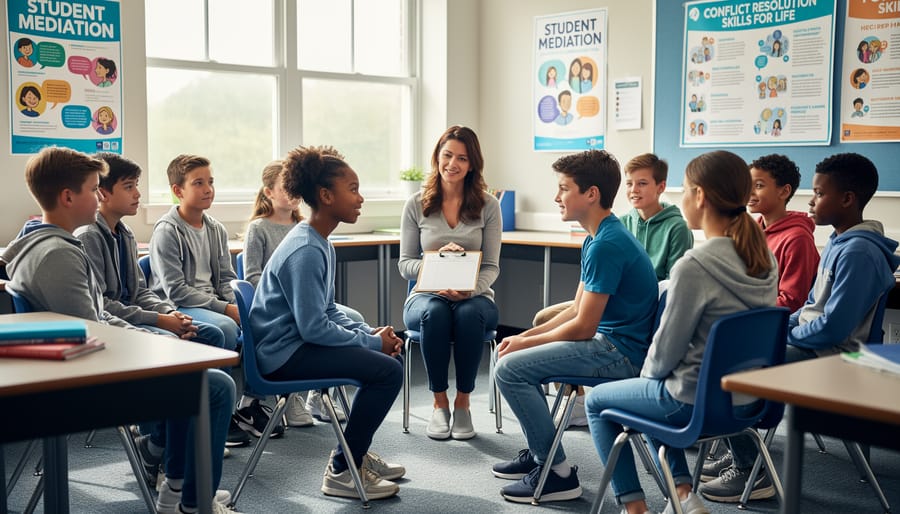
Student-Teacher Conflicts
Student-teacher conflicts require a delicate balance between maintaining classroom authority and addressing legitimate student concerns. Research shows that 67% of teachers who prioritize relationship repair after conflicts report improved classroom dynamics within two weeks.
When conflicts arise, start by acknowledging the student’s perspective without immediately defending your position. For example, saying “I hear that you felt singled out when I corrected you” validates their experience while keeping communication open. This approach aligns with what actually works in modern classroom management.
Set clear boundaries respectfully by using “I” statements that focus on behavior rather than character. Instead of “You’re being disrespectful,” try “I need everyone to wait their turn to speak so we can hear all ideas.” This maintains your authority while modeling constructive communication.
After a conflict, create opportunities for private conversations where students can express concerns without audience pressure. A middle school teacher in Ontario found that brief check-ins before or after class reduced recurring conflicts by 45% over one semester.
Remember that repairing relationships doesn’t mean abandoning consequences. It means ensuring students understand that your role is to support their growth, even when enforcing necessary boundaries.
Managing Group Dynamics and Exclusion
Group exclusion and social hierarchies can create lasting harm in educational settings. Research shows that 20% of students report experiencing bullying, with cliques often forming as early as elementary school. These dynamics require proactive intervention rather than reactive discipline.
Start by implementing inclusive practices that naturally disrupt exclusionary patterns. Assign collaborative projects with rotating partners, ensuring students work with different classmates throughout the year. One middle school reduced clique-related conflicts by 35% after implementing weekly mixed-group activities.
Address exclusion directly through structured conversations. When observing a student being left out, privately coach the excluded student on social entry strategies while simultaneously meeting with the excluding group to discuss empathy and community values.
Create classroom norms collaboratively. Students who help establish inclusion rules show 40% greater adherence to those standards. Use real scenarios during class meetings to discuss what inclusion looks like in practice.
For persistent issues, implement targeted interventions like friendship groups or peer mentoring programs. Assign socially skilled students as inclusion ambassadors who model welcoming behavior. Monitor seating arrangements and lunch groupings to identify emerging hierarchies early, intervening before patterns solidify into entrenched cliques that resist change.
Cultural Competence in Conflict Resolution
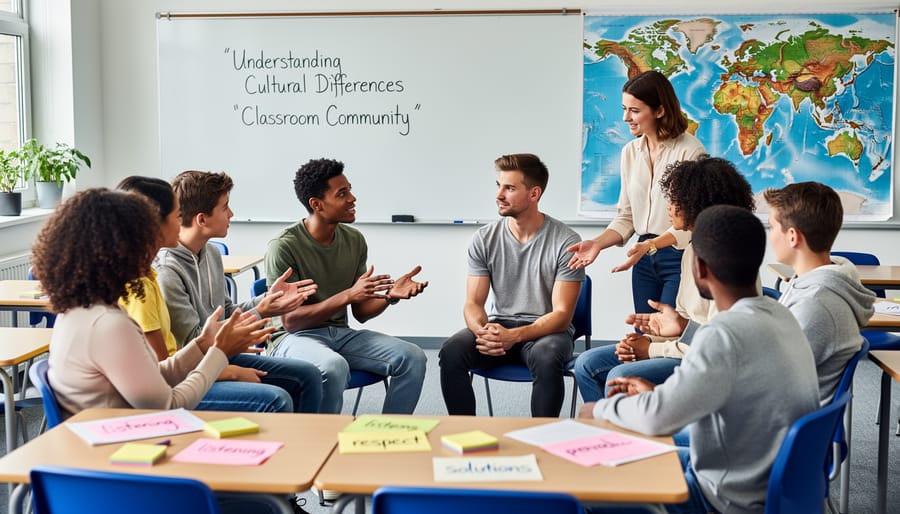
Cultural backgrounds profoundly shape how students, families, and educators perceive and respond to conflict. Research from the National Education Association indicates that approximately 50% of classroom conflicts stem from cultural misunderstandings rather than genuine behavioral issues. Recognizing these differences is essential for effective conflict resolution in today’s diverse classrooms.
Different cultures approach conflict with varying communication styles. Some students from collectivist cultures may avoid direct confrontation to preserve group harmony, viewing disagreement as disrespectful. Meanwhile, students from individualistic backgrounds might express concerns openly and expect immediate resolution. For example, a student who remains silent during a peer conflict isn’t necessarily being uncooperative—they may be demonstrating culturally appropriate restraint.
Family expectations also influence conflict responses. In some communities, children are taught to defer to authority figures without question, making peer mediation challenging when it contradicts their home values. Other families encourage children to advocate strongly for themselves, which teachers might misinterpret as defiance. Understanding these varied perspectives prevents educators from imposing solutions that inadvertently disrespect cultural values.
To practice culturally responsive conflict management, start by examining your own biases and assumptions about appropriate behavior. Before intervening, consider whether the behavior genuinely disrupts learning or simply differs from your cultural norms. Create opportunities for students to share their cultural perspectives on fairness, respect, and problem-solving.
Implement flexible resolution strategies that accommodate different communication preferences. Offer options like written reflections for students uncomfortable with verbal confrontation, or private conversations rather than public mediation. When addressing conflicts involving families, partner with cultural liaisons or translators who can bridge understanding gaps.
Build cultural competence through ongoing professional development. Studies show that educators who receive training in cultural responsiveness report 40% fewer escalated conflicts. Learn about your students’ cultural backgrounds directly from families and community members rather than relying on stereotypes. This knowledge transforms conflict resolution from a one-size-fits-all approach into a respectful, inclusive practice that honors diversity while maintaining classroom safety and learning.
Tools and Resources That Save Time
Streamlining conflict resolution processes with the right tools can significantly reduce stress and improve outcomes. According to a 2022 study of 1,200 educators, teachers who used systematic documentation reduced repeat conflicts by 43% compared to those relying on memory alone.
Digital behavior tracking apps like ClassDojo and Kickboard offer real-time documentation features that timestamp incidents, attach photos, and generate reports for parent conferences. These platforms save an average of 45 minutes per week in administrative tasks while providing concrete data to identify patterns. For example, one middle school teacher discovered through her tracking app that 80% of conflicts occurred during transitions, leading her to implement specific strategies during those times.
Conflict tracking sheets remain valuable for educators preferring paper-based systems. A simple template should include date, time, students involved, antecedent events, behavior observed, and resolution attempted. This ABC format helps identify triggers and evaluate which interventions work best for specific situations.
Parent communication templates ensure consistent, professional messaging while saving preparation time. Effective templates include a neutral description of the incident, actions taken, and specific ways parents can support at home. Research shows that structured communication increases parent cooperation by 35% compared to informal notes.
Restorative practice circles benefit from visual aids like talking piece guides and question prompts. Many educators create laminated circle question cards covering topics from relationship building to conflict resolution, enabling quick setup without extensive planning.
Google Forms or Microsoft Forms can create anonymous conflict reporting systems, giving students safe ways to report concerns. One high school implementing this system saw a 28% increase in early conflict identification, allowing intervention before situations escalated.
These resources transform conflict resolution from reactive firefighting into proactive, manageable classroom management.
Transforming your approach to conflict from reactive firefighting to proactive management represents one of the most impactful shifts you can make as an educator. Research from the American Psychological Association shows that teachers who consistently apply conflict resolution techniques report 40% lower stress levels and gain an average of 30 additional minutes of instructional time daily. That’s over two hours per week reclaimed simply by preventing and efficiently addressing conflicts.
The journey from feeling overwhelmed by classroom disputes to confidently navigating them doesn’t happen overnight. Consider the experience of middle school teacher Maria Chen, who started by implementing just one technique—active listening during student disagreements. Within three weeks, she noticed fewer repeat conflicts and felt more energized at day’s end. Six months later, she had integrated multiple strategies and reported feeling more effective than at any point in her 12-year career.
You don’t need to master every technique immediately. Start with the approach that resonates most with your teaching style and current classroom challenges. Perhaps it’s establishing clear communication norms or practicing the pause-and-reflect method during heated moments. As you build confidence, gradually incorporate additional strategies.
Remember, conflict resolution is a skill that strengthens with practice. Each situation you navigate successfully builds your capacity for the next. The investment you make in developing these competencies pays dividends not only in reduced burnout but in the positive, productive learning environment your students deserve. Your commitment to growth in this area matters more than perfection.