



Recognize that nearly half of all children in the United States have experienced at least one traumatic event, from divorce and neglect to community violence or natural disasters. When students arrive in your classroom carrying these experiences, traditional disciplinary approaches that rely on consequences and control often backfire, triggering stress responses instead of promoting learning. A fifth-grader who witnessed domestic violence may react to a raised voice with fight-or-flight behaviors, not defiance. A third-grader experiencing food insecurity might hoard snacks, not steal them.
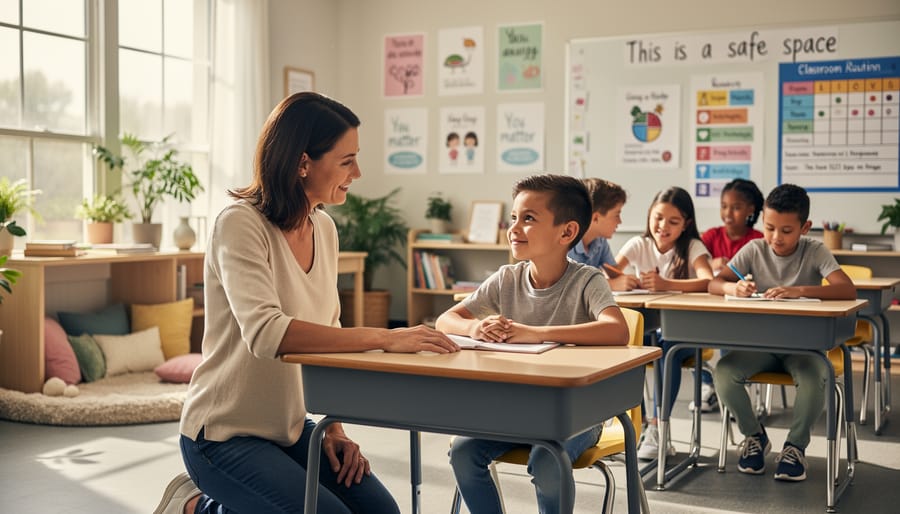
Trauma-informed teaching transforms classrooms into safe spaces where all students can learn by acknowledging how adversity affects brain development, behavior, and academic performance. This approach shifts the fundamental question from “What’s wrong with you?” to “What happened to you?” Research from the Substance Abuse and Mental Health Services Administration shows that students in trauma-informed classrooms demonstrate improved attendance, fewer behavioral incidents, and stronger academic outcomes compared to traditional settings.
Create predictable routines and clear expectations to help students feel secure. Offer choices within structured boundaries so learners regain a sense of control over their environment. Build genuine relationships through consistent, caring interactions that communicate unconditional positive regard. Respond to challenging behaviors with curiosity rather than punishment, investigating the underlying need the behavior attempts to meet.
This evidence-based framework doesn’t require specialized training in therapy or psychology. It demands intentional shifts in perspective and practice that benefit every student, whether they’ve experienced significant trauma or everyday stress. Understanding trauma-informed teaching equips educators to create classrooms where healing and learning happen simultaneously, addressing the whole child rather than just academic performance.
What Is Trauma-Informed Teaching?
The Four Rs of Trauma-Informed Approach
The trauma-informed approach rests on four foundational principles known as the Four Rs, which provide educators with a practical framework for creating supportive learning environments.
Realize involves understanding that trauma is widespread and significantly impacts learning. Research shows that approximately two-thirds of children experience at least one traumatic event by age 16. This awareness helps educators recognize that challenging behaviors often stem from past experiences rather than defiance or lack of motivation.
Recognize focuses on identifying the signs of trauma in students. These may include difficulty concentrating, heightened emotional responses, withdrawal from social interactions, or sudden changes in academic performance. For example, a student who flinches at loud noises or avoids eye contact might be displaying trauma responses. Recognizing these signs without making assumptions allows teachers to respond appropriately.
Respond means applying trauma-informed knowledge in daily interactions. This involves using calm, predictable communication, offering choices to restore a sense of control, and building trust through consistent, supportive relationships. When a student arrives late repeatedly, a trauma-informed response asks “What’s happening?” rather than immediately assigning consequences.
Resist Re-traumatization ensures that school policies, practices, and interactions don’t inadvertently trigger traumatic memories or create new trauma. This means avoiding punitive discipline that mirrors past harm, respecting personal boundaries, and creating physically and emotionally safe spaces. By implementing these four principles systematically, educators transform classrooms into healing environments where all students can thrive academically and emotionally.
Understanding How Trauma Affects Learning and Behavior
When trauma impacts the developing brain, it fundamentally changes how students process information and respond to their environment. The amygdala, our brain’s alarm system, becomes hypervigilant in traumatized students, constantly scanning for threats even in safe classroom settings. This biological response isn’t a choice—it’s an automatic survival mechanism.
Research from Harvard’s Center on the Developing Child shows that chronic stress floods the brain with cortisol, impairing the prefrontal cortex responsible for executive functions like attention, impulse control, and decision-making. This explains why a student who experienced trauma might struggle with focus similarly to students with ADHD, even without that diagnosis.
In classroom situations, traumatized students often exhibit fight, flight, or freeze responses. A student in “fight” mode might appear defiant, arguing with teachers or peers. “Flight” students may ask to leave frequently, avoid participation, or mentally check out. “Freeze” responses look like shutdown—blank stares, inability to respond, or seeming lazy when actually overwhelmed.
Consider this real example: A teacher reprimands a student for not completing homework. The student storms out, seeming disrespectful. However, understanding trauma reveals a different story—raised voices triggered a stress response from past domestic violence, causing an involuntary flight reaction.
Data from the Substance Abuse and Mental Health Services Administration indicates that two-thirds of children experience at least one traumatic event by age sixteen. This means traditional discipline approaches often misinterpret trauma responses as intentional misbehavior, inadvertently retraumatizing students rather than supporting their learning needs.
The Problem with Traditional Classroom Management
Real-Life Example: When Discipline Backfires
Consider Marcus, a fifth-grader who witnessed domestic violence at home. When his teacher asked him to put away his phone during class, Marcus became visibly agitated, refused to comply, and eventually stormed out of the classroom. His teacher, interpreting this as blatant defiance, sent him to the principal’s office and assigned detention.
What the teacher didn’t recognize was that Marcus’s phone was his lifeline to check on his mother’s safety. The demand to surrender it triggered a fight-or-flight response rooted in his traumatic experiences. Rather than defiance, his behavior was a survival mechanism.
The traditional disciplinary response created a negative cycle. Marcus felt misunderstood and unsafe at school, leading to increased absences and more behavioral incidents. His academic performance declined, and the relationship with his teacher deteriorated. According to research from the National Child Traumatic Stress Network, approximately 26% of children witness or experience a traumatic event before age four, yet their trauma responses are frequently misidentified as behavioral problems. When educators lack trauma-informed awareness, they may inadvertently re-traumatize students through punitive measures, missing opportunities to build trust and provide genuine support that addresses underlying needs.
Core Trauma-Informed Classroom Management Strategies
Building Safety and Predictability
Creating safety and predictability is fundamental to trauma-informed teaching. Students who have experienced trauma often live in heightened states of anxiety, making consistent routines and clear expectations essential for their academic success.
Physical safety begins with thoughtful classroom arrangement. Position desks to allow clear sightlines to exits, create quiet corners for students who need breaks, and maintain organized spaces that reduce sensory overload. One middle school teacher reported that simply rearranging her classroom to eliminate blind spots reduced anxiety-related disruptions by 40 percent within three weeks.
Emotional safety develops through predictable routines. Start each day the same way, use visual schedules, and provide advance notice of changes. Research from the National Child Traumatic Stress Network shows that students with trauma histories demonstrate 35 percent improvement in task completion when teachers implement consistent daily structures. A fifth-grade teacher shared how posting a visual timeline helped one student transition from frequent meltdowns to successfully navigating her entire school day.
Clear expectations reduce uncertainty. Display behavioral guidelines using positive language, establish predictable consequences, and maintain consistency in responses. When students know what to expect, their nervous systems can relax enough to engage in learning.
Creating this positive learning environment requires intentional planning. Use the same transition signals, maintain regular check-in times, and honor commitments to students. For example, if you promise individual meeting time, protect that appointment. This reliability demonstrates that your classroom is trustworthy—a critical foundation for traumatized students to take academic risks and grow.

Relationship-Based Discipline
Trauma-informed teaching recognizes that strong relationships form the foundation for learning and behavior management. Rather than responding to challenging behaviors with punishments that can reactivate trauma responses, educators using this approach prioritize connection and understanding.
This shift begins with simple yet powerful practices. Greeting each student individually at the classroom door creates a moment of recognition and allows teachers to assess each child’s emotional state before instruction begins. Research from the University of Missouri found that teachers who implemented personalized greetings saw a 20% increase in academic engagement and a 9% decrease in disruptive behavior.
The principle of “connection before correction” guides interactions when challenging behaviors arise. Instead of immediate consequences, trauma-informed educators pause to understand what the behavior is communicating. A student who refuses to work might be experiencing anxiety or hunger rather than defiance. This approach doesn’t eliminate boundaries but reframes them within supportive relationships.
Restorative practices replace traditional discipline by focusing on repairing harm and rebuilding relationships. When conflicts occur, restorative circles bring together affected parties to discuss impact and solutions collaboratively. A middle school in Portland implemented restorative practices and reduced suspensions by 40% within one year while improving school climate scores.
This relational approach also involves recognizing that behaviors often represent unmet needs or coping strategies. Teachers ask “What happened to you?” rather than “What’s wrong with you?” This subtle language shift opens dialogue and demonstrates that students are valued beyond their actions, creating the safety necessary for both healing and learning.
Recognizing and Responding to Triggers
Understanding trauma triggers in your classroom is essential for creating a safe learning environment. Triggers are sensory experiences or situations that remind students of past trauma, potentially causing sudden behavioral changes, withdrawal, or emotional outbursts.
Common classroom triggers often go unrecognized. Raised voices, even during enthusiastic teaching, can startle trauma-affected students. Unexpected schedule changes may trigger anxiety in children who desperately need predictability. Physical proximity during one-on-one instruction might feel threatening to students with certain trauma histories. Even seemingly positive activities like group work can overwhelm students who struggle with trust.
Research from the National Child Traumatic Stress Network indicates that approximately 26% of children witness or experience a traumatic event before age four, making trigger awareness critical for all grade levels.
Watch for warning signs: a student who suddenly becomes quiet after being talkative, exhibits fidgeting or restlessness, displays aggressive responses to minor issues, or attempts to leave the classroom. These behaviors often signal a triggered response rather than defiance.
Effective de-escalation begins with your own calm presence. Lower your voice rather than raising it, and give the student physical space. Offer choices to restore their sense of control, such as “Would you like to sit here or move to the quiet corner?” Avoid power struggles and questions beginning with “why,” which can feel accusatory.
Prevention strategies include establishing consistent routines, providing advance notice of changes, creating designated calm-down spaces, and teaching all students self-regulation techniques like deep breathing. Building strong relationships helps you recognize each student’s unique triggers and responses.
Teaching Self-Regulation Skills
Teaching self-regulation is a cornerstone of trauma-informed practice, equipping students with essential tools to manage their emotions and responses. Research shows that students who learn regulation strategies demonstrate 30% fewer behavioral incidents and improved academic performance.
Creating dedicated calm-down corners in classrooms provides safe spaces where students can reset when overwhelmed. These areas should include comfortable seating, sensory materials, and visual guides for breathing exercises. One elementary teacher in Oregon reported that implementing such spaces reduced classroom disruptions by half within three months.
Breathing techniques offer immediate, portable regulation tools. The “5-5-5 method” (inhale for 5 counts, hold for 5, exhale for 5) activates the parasympathetic nervous system, calming stress responses. Teaching these techniques during calm moments ensures students can access them during distress.
Mindfulness integration through brief daily practices helps students develop awareness of their emotional states. Simple activities like body scans or mindful listening to music for three to five minutes can significantly improve focus and self-awareness.
Providing fidget tools allows kinesthetic learners to regulate through movement while maintaining engagement. These evidence-based strategies create a classroom environment where all students can develop lifelong emotional regulation skills.
Flexible Responses Over Rigid Rules
Trauma-informed teaching recognizes that traditional discipline systems often fail students dealing with trauma. Rather than applying identical consequences to every situation, effective educators maintain clear expectations while adjusting responses based on individual circumstances. For example, a student who misses homework deadlines might need connection with a school counselor rather than automatic detention, especially if trauma affects their home environment.
Research from the National Child Traumatic Stress Network shows that punitive approaches can actually retriggert traumatic responses, making behavior worse. Instead, teachers can establish consistent classroom structures—like predictable routines and transparent expectations—while building in flexibility for how students demonstrate learning or make amends after conflicts.
This approach doesn’t mean eliminating accountability. A student struggling with outbursts might have a personalized calm-down plan that allows brief breaks, while still being responsible for completing work and repairing relationships. By understanding that trauma affects self-regulation differently across students, teachers create safer learning environments where structure supports rather than punishes struggling learners.
What Trauma-Informed Teaching Looks Like in Practice
Elementary Classroom Case Study
When Mrs. Rodriguez noticed that five students in her third-grade class consistently arrived dysregulated each morning, she redesigned her approach using trauma-informed principles. She replaced her standard bell-work routine with a 15-minute soft-start period where students could choose calming activities like coloring, reading, or quiet conversation before academic work began.
For conflict resolution, she shifted from immediate consequences to a regulation-first model. When conflicts arose, she provided a cool-down corner with sensory tools and taught students simple breathing techniques before discussing what happened. Mrs. Rodriguez also implemented predictable daily schedules posted with visual supports and gave five-minute warnings before transitions.
The results were remarkable. Over one semester, classroom disruptions decreased by 60 percent, and office referrals dropped from an average of three per week to fewer than one per month. Student survey data showed that 85 percent of her class reported feeling safer and more supported. Perhaps most significantly, the five students who initially struggled began participating more actively in lessons, with four showing measurable academic growth on quarterly assessments. This real-world example demonstrates how small, intentional changes rooted in understanding student needs can transform classroom dynamics and learning outcomes.
Secondary Classroom Application
In a high school English classroom, Ms. Rodriguez noticed several students consistently arriving late, appearing disengaged, or reacting defensively to feedback. Rather than implementing punitive measures, she adopted trauma-informed strategies tailored to adolescent needs. She redesigned her classroom to include a “decompression corner” with stress balls and fidget tools, acknowledging that teenagers experiencing trauma often need physical outlets for regulation.
Ms. Rodriguez also restructured her feedback approach, offering written comments that emphasized growth and specific strengths before addressing areas for improvement. When a student submitted work late, she privately asked, “What support do you need to complete this?” instead of automatically applying grade penalties. She incorporated student choice in assignments, allowing learners to demonstrate understanding through various formats like podcasts, presentations, or traditional essays.
Data from her classroom showed a 40% decrease in behavioral referrals and a 25% improvement in assignment completion rates within one semester. Students reported feeling more respected and understood. This example demonstrates how trauma-informed teaching adapts to older students by honoring their developing autonomy while providing the safety and predictability essential for learning.
The Benefits: Why This Approach Works for All Students
Research consistently demonstrates that trauma-informed teaching creates measurable benefits for all students, not just those who have experienced trauma. A comprehensive study by the University of Washington found that schools implementing trauma-informed practices saw suspension rates drop by 33% within two years, while academic achievement scores increased across all student demographics.
When teachers adopt a trauma-informed approach, they create learning environments where every student feels safer and more supported. Data from Pennsylvania’s trauma-informed schools initiative revealed that attendance rates improved by 15% and chronic behavioral referrals decreased by 40%. Perhaps most significantly, students in trauma-informed classrooms showed a 25% improvement in their ability to self-regulate emotions and manage stress.
These positive outcomes extend beyond individual metrics. Schools that embrace inclusive classroom practices rooted in trauma-informed principles report dramatic improvements in overall classroom climate. Teachers experience less burnout and greater job satisfaction when equipped with strategies that address the root causes of challenging behaviors rather than simply reacting to symptoms.
Academic performance benefits are equally compelling. A three-year longitudinal study tracking 1,200 students found that those in trauma-informed classrooms demonstrated 18% higher reading proficiency and 22% better math scores compared to control groups. These gains were particularly pronounced among students from marginalized communities, helping to narrow achievement gaps.
The universal design principles inherent in trauma-informed teaching, such as predictable routines, clear expectations, and relationship-building, benefit every learner. Students who have never experienced trauma still thrive in environments that prioritize emotional safety, responsive relationships, and developmentally appropriate practices. This approach essentially raises the baseline for all students while providing crucial support for those who need it most.
Getting Started: First Steps for Educators
Transitioning to trauma-informed teaching doesn’t require a complete classroom overhaul. Instead, educators can begin with manageable steps that create meaningful change for students who have experienced trauma.
Start by building your knowledge foundation. Seek out professional development opportunities focused on childhood trauma, adverse childhood experiences (ACEs), and their impact on learning. Many school districts now offer trauma-informed training, and online platforms provide accessible courses for educators at various experience levels. Research shows that teachers who complete even basic trauma-informed training report feeling 40% more confident in managing challenging behaviors.
Focus on small, sustainable changes first. Begin each day with a consistent greeting routine that helps students feel seen and valued. Establish predictable classroom structures, as students affected by trauma often find security in knowing what comes next. Create a designated calm-down corner with sensory tools, giving students a safe space to regulate emotions without punishment or shame.
Prioritize your own well-being throughout this journey. Trauma-informed teaching can be emotionally demanding, making self-care essential rather than optional. Set boundaries around work hours, connect with colleagues for support, and engage in activities that restore your energy. A teacher experiencing burnout cannot effectively support students navigating trauma.
Connect with your school’s support team, including counselors, social workers, and administrators. Trauma-informed practice works best as a collective effort rather than isolated classroom attempts. Share observations about student needs and collaborate on intervention strategies.
Start a reflection practice to track your progress. Note which strategies resonate with your students and which need adjustment. One elementary teacher discovered that allowing flexible seating reduced behavioral incidents by 60% within three weeks, simply by giving trauma-affected students more control over their environment.
Remember that implementing trauma-informed approaches is a journey, not a destination. Each small step creates a more supportive, responsive classroom environment where all students can thrive.

Trauma-informed teaching represents a fundamental shift in how we approach classroom management—one grounded in compassion, brain science, and the recognition that behavior is communication. This approach doesn’t lower expectations or excuse harmful actions. Instead, it creates conditions where all students, regardless of their past experiences, can access learning and reach their full potential.
The evidence is compelling. Schools implementing trauma-informed practices report decreased disciplinary incidents by 30-50%, improved attendance rates, and measurable gains in academic achievement. When a middle school in Philadelphia adopted these strategies, suspension rates dropped 40% within one year while reading scores increased. These aren’t isolated success stories—they represent what becomes possible when we align our teaching practices with what we know about how stress and trauma affect the developing brain.
Importantly, becoming trauma-informed doesn’t require educators to become therapists or mental health professionals. It requires being informed about how adversity impacts learning, responsive to students’ needs, and committed to creating predictable, safe environments where healing can occur alongside education. Small adjustments—consistent routines, choices within structure, relationship-building, and understanding behavior through a regulatory lens—can transform classroom dynamics.
As you implement these practices, remember that trauma-informed teaching benefits every student. Creating emotionally safe, structured, responsive classrooms isn’t just good practice for students who have experienced hardship—it’s exemplary teaching for all learners. This evolution in classroom management honors both the complexity of students’ lives and the transformative power of education.