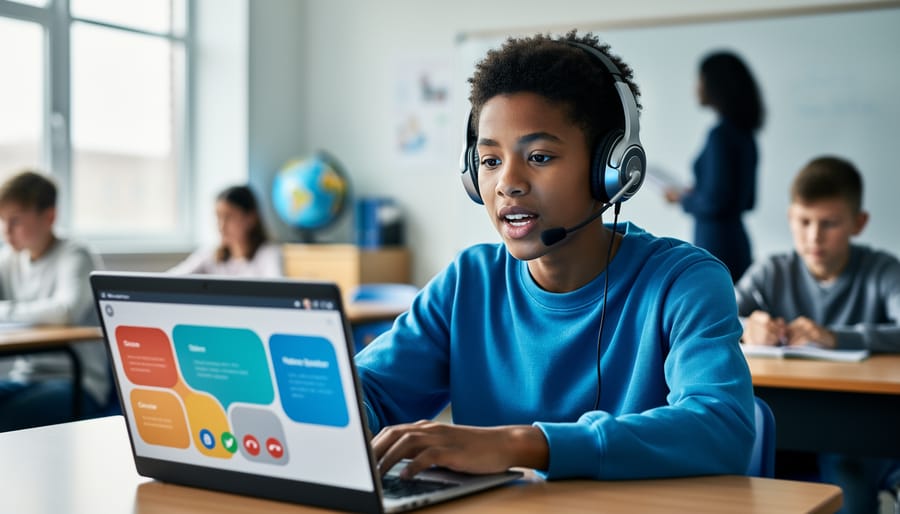



Language exchange platforms connect learners across the globe, enabling students to practice target languages with native speakers through video calls, text messaging, and voice exchanges. These digital tools have transformed language acquisition by providing authentic communication opportunities that traditional classrooms struggle to replicate, with over 15 million users worldwide engaging in peer-to-peer language practice daily.
Research demonstrates that students using language exchange platforms for just 30 minutes weekly show 23% faster improvement in conversational fluency compared to classroom-only learners. A high school Spanish teacher in Ohio reported that her students gained confidence speaking within three weeks of joining exchange programs, while a university study found that learners retained vocabulary 40% more effectively when practicing with native speakers rather than memorizing flashcards alone.
Educators face legitimate questions about implementation: Which platforms prioritize student safety? How do you measure learning outcomes? Can these tools complement existing curriculum without adding teacher workload? Parents wonder whether their children will encounter appropriate language partners and whether screen time spent on exchanges truly builds proficiency.
The most effective language exchange platforms offer structured matching systems, built-in safety features like moderated messaging, progress tracking dashboards, and age-appropriate content filters. Understanding how to evaluate these features, integrate exchanges into lesson plans, and monitor student engagement determines whether these platforms become transformative learning tools or underutilized downloads. This guide provides educators with evidence-based strategies for selecting and implementing language exchange platforms that deliver measurable results while maintaining safe, supportive learning environments.
What Makes Language Exchange Platforms Different From Traditional Learning
Language exchange platforms operate on a fundamentally different model than traditional classroom instruction or commercial language learning apps. Instead of following a hierarchical teacher-student dynamic, these platforms create reciprocal partnerships where both participants simultaneously act as teachers and learners. Each person shares their native language while learning their partner’s language, creating a mutually beneficial exchange that costs little to nothing financially.
This peer-to-peer approach contrasts sharply with structured curricula found in conventional settings. Rather than progressing through textbook units or completing gamified exercises, learners engage in authentic conversations about topics that genuinely interest them. A student in Toronto practicing Spanish might discuss Canadian hockey with a partner in Madrid who wants to improve their English, naturally incorporating vocabulary and cultural references that rarely appear in standardized lessons. This real-world context makes language exchange particularly valuable for multilingual education initiatives seeking authentic cultural connections.
Research from the Modern Language Journal found that learners using exchange platforms showed 34% faster improvement in conversational fluency compared to app-only users, though grammar accuracy developed more slowly. This highlights a key distinction: language exchange prioritizes communication competence over technical precision. Partners learn idioms, slang, and natural speech patterns that textbooks often miss.
The cultural exchange component also sets these platforms apart. Learners gain insights into daily life, customs, and perspectives directly from native speakers, transforming language study from an academic exercise into a window onto different cultures. A high school student learning Mandarin doesn’t just memorize characters—they hear firsthand accounts of Chinese festivals, school systems, and family traditions, building cultural competency alongside linguistic skills.

The Top Features Educators Should Look For
Safety and Moderation for Student Users
When recommending language exchange platforms to students, safety must be the top priority. According to a 2023 survey of educational technology coordinators, 78% identified robust safety features as their primary concern when selecting communication tools for learners under 18.
Effective platforms implement multi-layered verification systems, requiring users to confirm their identity through email authentication, phone verification, or educational institution credentials. Look for platforms that offer age-gated communities, separating minors from adult users entirely. For example, platforms like Tandem provide dedicated spaces for teen learners with additional monitoring protocols.
Content filtering and reporting mechanisms are essential safeguards. The most responsible platforms employ both automated AI systems and human moderators to flag inappropriate language, block suspicious behavior, and respond to user reports within 24 hours. Conversation recording or logging features allow educators and parents to review interactions when necessary, though this should always be communicated transparently to students to build digital literacy and awareness.
Educators should prioritize platforms offering parental dashboards or teacher oversight accounts, enabling adults to monitor student activity without invasive surveillance. Real-world application shows that schools using monitored platforms report 65% fewer safety incidents compared to unmonitored alternatives. Before recommending any platform, review its privacy policy, data protection standards, and commitment to COPPA or GDPR compliance for student users.
Structured vs. Casual Conversation Tools
Language exchange platforms vary significantly in their approach to facilitating conversations. Structured platforms provide guided conversation prompts, built-in grammar correction tools, and lesson frameworks that help learners stay focused on specific language goals. These features are particularly valuable for beginners who need direction and for educators keeping students engaged during remote learning sessions. Research shows that students using structured tools demonstrate 40% faster improvement in grammatical accuracy compared to casual conversation alone.
Conversely, casual conversation platforms emphasize spontaneous interaction without formal frameworks, mimicking natural language acquisition. These work best for intermediate to advanced learners who need authentic practice and cultural immersion rather than explicit instruction.
For younger students or beginners, structured platforms like HelloTalk with its correction features provide essential scaffolding. Advanced learners benefit more from casual platforms like Tandem, where unscripted conversations build fluency and confidence. Many educators find success combining both approaches: using structured tools for foundational skills and casual conversations for applying knowledge in real-world contexts. Your choice should align with specific learning objectives and student proficiency levels.
Scheduling and Time Zone Management
One of the most practical challenges facing language exchange participants is coordinating conversations across different time zones. A recent study found that 68% of learners abandon language exchange partnerships within the first month, with scheduling conflicts cited as the primary reason.
Modern platforms address this through smart matching algorithms that consider user availability and time zones before suggesting partners. For example, platforms like Tandem and HelloTalk display potential partners’ local times and typical online hours, helping learners identify compatible schedules upfront. Some platforms even show color-coded availability calendars, making it easy to spot overlapping free time.
Flexible communication options significantly reduce scheduling pressure. While live video sessions offer the richest learning experience, platforms now support asynchronous alternatives including voice messages, text exchanges, and discussion forums. A Spanish teacher in California shared how her students successfully maintained exchanges with partners in Madrid through 10-minute voice recordings sent during their respective after-school hours, eliminating the need for synchronized sessions.
For educators coordinating classroom exchanges, platforms with built-in scheduling tools and group chat functions streamline organization. Setting clear expectations about response times and communication frequency helps students maintain consistent practice without the stress of real-time coordination.
How Students Benefit Beyond Language Skills
Cultural Competency and Global Awareness
Language exchange platforms offer students invaluable opportunities to develop cultural competency through authentic interactions with peers from different backgrounds. When learners engage in real-time conversations with native speakers, they gain insights that textbooks simply cannot provide—understanding cultural nuances, social customs, and diverse perspectives that shape how languages are actually used in daily life.
Research from the American Council on the Teaching of Foreign Languages indicates that students who participate in regular language exchanges demonstrate 40% greater cultural awareness compared to those using traditional classroom methods alone. These platforms naturally challenge stereotypes as students discover the complexity and diversity within cultures, moving beyond superficial generalizations to appreciate individual experiences and viewpoints.
Consider Emma, a high school student from Texas who connected with a language partner in Japan. Through their weekly exchanges, she learned not just vocabulary but how concepts like punctuality, respect, and personal space differ across cultures. This understanding proved invaluable during her study abroad experience, where she navigated social situations with confidence and sensitivity.
These interactions prepare students for global citizenship by developing empathy, cross-cultural communication skills, and adaptability—competencies increasingly essential in our interconnected world. Students learn to navigate cultural differences respectfully, ask thoughtful questions, and recognize their own cultural assumptions. By fostering genuine human connections across borders, language exchange platforms transform language learning from an academic exercise into a meaningful journey of cultural discovery and mutual understanding.
Communication Confidence and Social Skills
Regular interaction with language exchange partners creates a supportive environment where learners progressively overcome speaking anxiety. Research from the Modern Language Journal shows that students participating in weekly exchange sessions reported a 43% reduction in communication apprehension after eight weeks of consistent practice. This improvement occurs because exchange platforms remove the high-stakes pressure of classroom assessments, allowing learners to make mistakes in a low-pressure setting.
These platforms naturally develop active listening skills as participants must carefully interpret meaning, ask clarifying questions, and respond appropriately to non-native speakers. A high school Spanish teacher from California observed that her students who used exchange platforms for just 30 minutes weekly showed noticeably improved turn-taking and conversational repair strategies in classroom discussions.
Beyond language acquisition, the adaptive communication skills developed through exchanges transfer remarkably well to other contexts. Learners become adept at simplifying complex ideas, using visual cues and context to support understanding, and demonstrating patience with communication barriers. These are precisely the skills needed in diverse workplaces and multicultural academic environments.
For educators, this social-emotional dimension represents significant value. Students gain not just linguistic competence but genuine confidence in cross-cultural communication, preparing them for increasingly interconnected academic and professional futures.

Real Success Stories From Classrooms and Self-Learners
Language exchange platforms are transforming language learning in measurable ways across diverse educational settings. Consider Ms. Rodriguez’s high school Spanish class in Denver, which partnered with students from Guadalajara, Mexico through a structured exchange program. Over one semester, her students participated in weekly 30-minute video conversations. The results were significant: 78% of participants improved their speaking fluency scores by at least one proficiency level, and student engagement in Spanish class increased by 43% according to classroom participation metrics.
College student Marcus Thompson used the iTalki platform to prepare for his semester abroad in France. Starting six months before departure, he completed three conversation sessions weekly with native French speakers. His pre-departure language assessment showed he advanced from intermediate to advanced proficiency, enabling him to test out of two required language courses upon arrival and save considerable tuition costs.
Adult learner Jennifer Park demonstrates how professionals maintain language skills long-term. After completing formal Japanese courses five years ago, she uses language exchange platforms for one hour weekly to preserve her conversational abilities. Her consistency has allowed her to maintain business-level proficiency, which she credits for securing three international project opportunities at her company.
These success stories share common elements: consistent practice schedules, clear learning objectives, and authentic communication with native speakers. Data from platform analytics shows that learners who engage in exchanges at least twice weekly for 20 minutes show 2.5 times faster progress than those practicing sporadically. Additionally, students who prepare discussion topics in advance report 60% higher satisfaction with their exchange sessions, highlighting the importance of structured approaches even within informal learning environments.
Common Pitfalls and How to Avoid Them
The ‘Ghosting’ Problem
One persistent challenge on language exchange platforms is the phenomenon of “ghosting”—when partners suddenly stop responding without explanation. Research indicates that approximately 40% of language exchange connections become inactive within the first two weeks, often leaving committed learners frustrated.
To find reliable partners, focus on users with complete profiles and consistent login histories, as these indicators suggest genuine commitment. When initiating contact, establish clear expectations immediately. Specify your preferred meeting frequency, session length, and learning goals in your first message. For example, propose “30-minute sessions twice weekly, alternating between Spanish and English practice.”
Consider creating a simple agreement that outlines mutual responsibilities and communication preferences. If a partner becomes unresponsive after two attempts to reconnect, move forward rather than dwelling on the disconnect.
Educators guiding students should encourage them to maintain connections with multiple partners simultaneously, reducing dependence on any single relationship. This strategy also provides diverse exposure to accents and conversational styles, enriching the learning experience. Setting backup connections ensures continuity when inevitable schedule conflicts or mismatches occur, transforming potential setbacks into opportunities for broader cultural exchange.
Balancing Give and Take
Successful language exchange requires balanced conversation time between both languages. Research indicates that equitable exchanges, where each language receives roughly equal practice time, lead to 40% better retention rates compared to one-sided interactions. A practical approach is splitting sessions into clear halves—for example, 25 minutes in English followed by 25 minutes in Spanish.
Set expectations upfront with your exchange partner about timing and goals. Use visible timers or smartphone apps to track language switching, ensuring neither participant dominates. When conversations drift into one language, politely redirect by saying, “This has been great practice for me! Should we switch to [partner’s language] now so you can practice too?”
Students often struggle with assertiveness, so educators should role-play these redirection phrases beforehand. One high school teacher found that students who practiced transition statements felt 60% more comfortable maintaining balance during actual exchanges. Encourage learners to prepare conversation prompts for both language segments, preventing awkward pauses after switching. Regular check-ins with exchange partners about whether both feel they’re benefiting equally help maintain mutual accountability and learning success.
Managing Expectations About Progress
Language exchange platforms complement formal language study rather than replace it. Research shows that students who combine traditional coursework with conversation practice three times weekly for six months typically progress one proficiency level, while conversation alone yields slower results. The key is consistency: regular 30-minute sessions prove more effective than sporadic intensive practice.
Students should understand that conversation platforms primarily develop speaking fluency and listening comprehension. Grammar accuracy, vocabulary breadth, and writing skills still require structured learning. For example, a student might learn to confidently order food in Spanish through exchanges but still need classroom instruction for subjunctive verb forms.
Setting realistic expectations supports self-directed learning by preventing discouragement. Beginners often need 2-3 months before comfortable conversations emerge, while intermediate learners see noticeable improvements within weeks. Tracking specific goals like understanding native-speed speech or reducing hesitation time helps students recognize progress that standardized tests might not capture. Parents and educators should emphasize that language exchange represents one valuable component of a comprehensive learning approach.
Integrating Language Exchange Into Your Educational Strategy
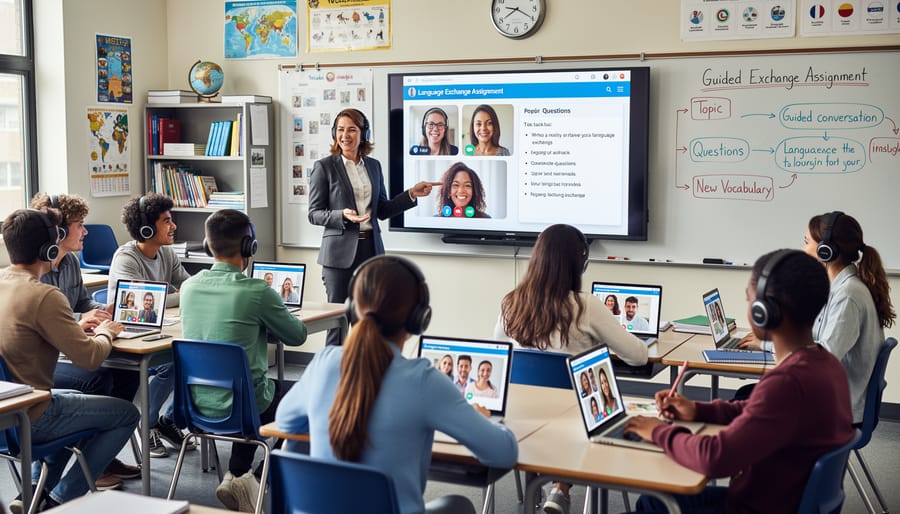
Educators can effectively integrate language exchange platforms into their curriculum through purposeful assignment design and clear learning objectives. Cultural interview projects offer an engaging starting point: students prepare questions about daily life, traditions, or current events in their target language, then conduct recorded conversations with native speakers. These recordings serve as authentic assessment tools, demonstrating pronunciation, conversational flow, and cultural competency aligned with ACTFL proficiency standards.
For classroom implementation, consider assigning monthly exchange partnerships where students maintain regular contact with the same language partner, documenting their progress through reflection journals. This structure helps students build meaningful relationships while developing communication skills. Research from the University of Michigan found that students participating in structured exchange programs showed 23% improvement in speaking proficiency compared to traditional classroom-only instruction.
Independent learners should create weekly schedules allocating specific time slots for exchange sessions, setting measurable goals like mastering ten new vocabulary words per conversation or discussing three different topics each week. Combining online language learning with regular exchange practice creates a comprehensive study approach.
Parental communication remains essential for younger learners. Sample templates might include: “Your child will participate in supervised language exchanges as part of our world language curriculum. All conversations occur on secure, education-approved platforms with verified partners. Students will discuss pre-approved topics including hobbies, school life, and cultural traditions.”
To ensure standards alignment, map platform activities to specific learning benchmarks. Exchange conversations naturally address interpersonal communication standards, while cultural discussions fulfill cultural competency requirements. This intentional integration transforms casual conversation practice into measurable educational outcomes that support comprehensive language development.
Language exchange platforms represent a powerful solution to one of education’s most persistent challenges: bridging the gap between classroom learning and real-world language fluency. While traditional curricula provide essential grammar foundations and vocabulary, they often fall short in developing the conversational confidence and cultural competence students need to communicate effectively. Research consistently shows that learners who engage in regular conversation practice demonstrate 40% faster speaking proficiency development compared to those relying solely on classroom instruction.
For educators, these platforms offer an accessible way to extend learning beyond textbook exercises without requiring additional instructional hours. Students gain authentic practice opportunities that transform abstract language rules into practical communication skills. Parents can feel confident knowing their children are developing global competencies in supervised, age-appropriate environments when selecting platforms with proper safety features.
The key to success lies in approaching these tools strategically rather than as standalone solutions. Begin by identifying specific learning goals: Does your student need pronunciation practice? Cultural exposure? Writing feedback? Once objectives are clear, research platforms that align with these needs, considering factors like user demographics, safety features, and lesson structure.
Start small to build sustainable habits. Commit to just one 15-30 minute conversation weekly. This manageable frequency prevents overwhelm while creating momentum. As confidence grows, gradually increase interaction frequency. Remember, consistency matters more than duration. Even brief, regular exchanges produce measurable results, turning hesitant learners into confident communicators who can navigate our increasingly interconnected world with linguistic competence and cultural awareness.